

Table of Contents
ToggleIntroduction
Every day, thousands of people start Affiliate marketing hoping to earn money online. The problem is that most beginners focus on affiliate links before understanding how traffic, content, and trust actually work. Here is the important point is affiliate marketing for beginners is not about posting links everywhere. It’s about helping people to solve their problems, building an audience, and recommending products that genuinely add value to your customers.
After studying successful affiliate websites, SEO-driven blogs, and affiliate content strategies across multiple niches, i am very clear that affiliate marketing usually rewards consistency far more than shortcuts.
The people generating affiliate commissions today are often those who have spent months building content, traffic, and audience trust before seeing significant results.
In this guide, you’ll learn exactly how affiliate marketing works, how beginners can start from scratch in 2026, and the step-by-step process used to earn your first affiliate commission online.
Key Takeaways
- Affiliate marketing is a performance-based business model where affiliates earn commissions by promoting products or services through unique tracking links.
- Affiliate programs allow beginners to earn online without creating products, managing inventory, or handling customer support.
- A profitable niche combines audience demand, monetisation potential, and manageable competition.
- SEO traffic remains one of the most sustainable methods for generating long-term affiliate commissions.
- High-quality content that solves real problems converts better than aggressive promotional content.
- Trust and consistency matter more than posting affiliate links everywhere.
- Affiliate marketing is a long-term business model that usually requires months of content creation and traffic growth before significant earnings appear.
What Is Affiliate Marketing and How Does It Work?
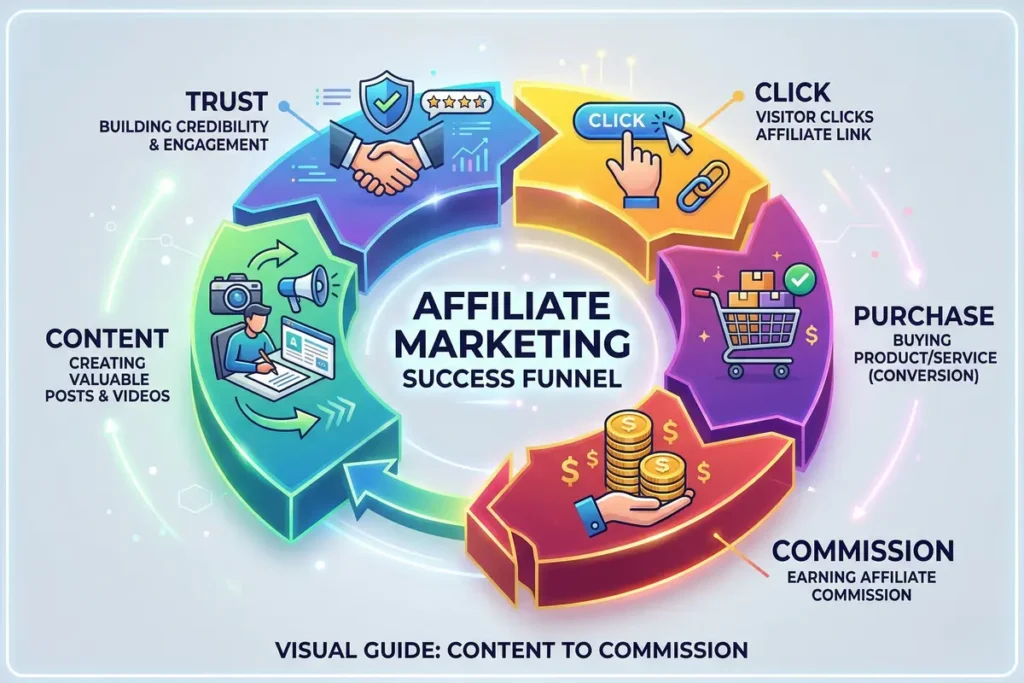
Affiliate marketing is a simple way to earn money online by recommending other companies’ products or services. When someone buys through your unique affiliate link, you earn a commission.
You can think of it like this:
- You recommend a product.
- Someone clicks your affiliate link.
- They make a purchase.
- You earn a commission.
For example, if you write a blog post about the best web hosting for beginners and recommend a hosting company using your affiliate link, you can earn money every time someone buys through that link.
The best part is that you don’t need to create your own product, manage inventory, handle shipping, or deal with customer support. Your job is simply to help people find useful products and services.
Affiliate marketing usually involves 4 main people:
Affiliate marketing for Beginners involves four main participants.
- Merchant – The company selling the product.
- Affiliate – The person promoting the product.
- Customer – The person buying the product.
- Affiliate Network – The platform that tracks sales and commissions.
It’s not about sharing links and waiting for results. In reality, successful affiliate marketing is about building trust, creating helpful content, and recommending products that genuinely solve problems.
That’s why people who focus on helping their audience usually earn more than those who only focus on selling.
For example, a beginner blogger may join Amazon Associates, promote products through articles, and earn commissions when visitors purchase through those links
How Do Affiliate Links Track Sales and Commissions?
Affiliate links contain unique tracking identifiers that allow merchants to attribute sales to specific affiliates.
When someone clicks your affiliate link, a tracking cookie is stored in their browser. If they complete a purchase within the cookie duration, the sale is credited to your account.
For example, Amazon Associates typically uses a 24-hour cookie window. If a customer buys within that period, you receive credit for the sale.
Affiliate commissions are earned when a customer completes a predefined action, such as a purchase, a subscription, or a lead submission, through an affiliate link.
Why Is Affiliate Marketing Important in 2026?
Affiliate marketing is one of the easiest ways to start an online business because you don’t need to create your own product, manage inventory, or handle customer support. You can focus on creating content, building an audience, and recommending products that genuinely help people.
The industry is also growing very fast. According to recent affiliate marketing reports, the global affiliate marketing market is expected to grow from $27.8 billion in 2024 to nearly $48 billion by 2027. Source – firstpromoter.
Additionally, over 80% of brands now use affiliate marketing programs to increase sales and reach new customers.
Low Startup Costs
One of the biggest reasons beginners choose affiliate marketing for beginners is the low investment required to get started.
You don’t need a large budget or a team. Many people start with:
- A simple blog
If you want to build a profitable blog, read my post “How to Start a Blog That Makes Money.”
- A YouTube channel
- An Instagram page
- A Facebook page
You can also use free tools like Google Docs, Canva, and Google Search Console in the beginning before investing in premium software.
Passive Income Potential
You can generate income even from content you published months ago.
For example, if your blog post ranks on Google and people keep reading it, your affiliate links can continue generating commissions without creating new content every day.
That’s why affiliate marketing is often included among the best passive income ideas online.
Work From Anywhere
Affiliate marketing gives you location freedom.
All you need is a laptop and an internet connection. That’s why students, freelancers, creators, and stay-at-home workers often use affiliate marketing as a side hustle or full-time online business.
The Industry Is Still Growing
Affiliate marketing is not slowing down. In fact, more companies are investing in it every year.
Recent data shows that 81% of brands worldwide run affiliate programs, and many businesses earn several dollars in revenue for every $1 spent on affiliate marketing. Source – Post Affiliate.
This growth means more affiliate programs, more earning opportunities, and more chances for beginners to build a long-term online income source.
Is Affiliate Marketing Worth It for Beginners in 2026?
Yes, affiliate marketing is still worth it for beginners in 2026, but only if you’re ready to treat it like a real business instead of a quick money shortcut.
One pattern I noticed while analysing affiliate websites is that most successful affiliates focus heavily on content and traffic first. Very few websites generate consistent commissions without publishing helpful content regularly.
According to an Ahrefs affiliate marketing study, beginners with less than one year of experience earn an average of around $636 per month, while experienced affiliates often earn much more through SEO, content marketing, and audience trust.
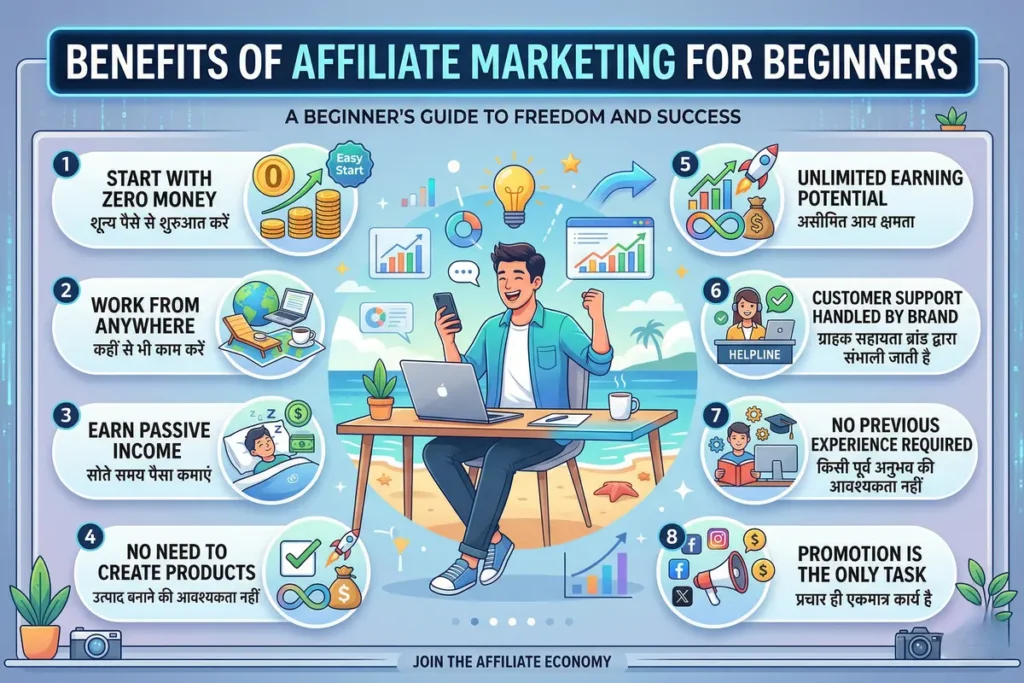
Why should you choose Affiliate Marketing?
You should choose it Because You:
- don’t need to create your own product.
- can start alongside a job or college.
- can work from anywhere.
- can scale without hiring a team immediately.
For example, a single blog post or YouTube video can keep bringing traffic and affiliate commissions for months if it ranks well on Google or YouTube.
What Makes Affiliate Marketing Difficult?
Affiliate marketing looks simple, but competition is much higher now than it was a few years ago.
To succeed, you need:
- Helpful content
- Basic SEO knowledge
- Audience trust
- Consistency
The biggest mistake beginners make is focusing only on affiliate links. In reality, people buy from creators they trust. That’s why successful affiliate marketers spend more time helping their audience than selling products.
If you’re willing to learn, stay consistent, and focus on providing value, affiliate marketing can become a long-term income source instead of just another side hustle experiment.
How Much Money Can Beginners Make With Affiliate Marketing?
Affiliate marketing income depends on your niche, traffic, content quality, and how well your audience trusts your recommendations. Some beginners make their first commission within a few weeks, while others take several months before seeing results.
The truth is that most beginners don’t earn much in the beginning because they’re still learning SEO, creating content, and building traffic.
Realistic Beginner Timeline
Time Period | What Usually Happens |
Month 1–3 | Learning, niche research, and publishing content |
Month 3–6 | First clicks, traffic growth, and small commissions |
Month 6–12 | More Google rankings and consistent traffic |
12+ Months | Potential recurring affiliate income |
One thing that becomes obvious when I study successful affiliate websites growth usually looks slow in the beginning and faster later with experience.
I saw Many sites publish dozens of articles before traffic starts increasing significantly.
Then, once rankings improve, commissions often grow much faster because multiple content pieces start generating traffic at the same time.
Many websites publish 50–100 helpful articles before seeing strong results. That’s why consistency matters more than chasing shortcuts.
Instead of focusing on how much money you can make in your first month, focus on building content, gaining traffic, and helping your audience. The income usually follows after that.
How Do You Choose a Profitable Affiliate Marketing Niche?
Choosing the right niche is one of the most important steps in affiliate marketing. A profitable niche is not just something you like – it should also have audience demand, products to promote, and enough content opportunities for long-term growth.
Many beginners quit because they choose random niches without checking whether people are actually searching for them or buying products in that category.
Focus on Interest + Profitability
A good niche should be something you can talk about for months without getting bored.
For example, if you’re interested in technology, creating content about AI tools, blogging software, or web hosting will be much easier than forcing yourself to write about topics you don’t enjoy.
Check If People Are Searching for It
Before choosing a niche, make sure people are actively searching for related topics online.
You can use tools like:
- Google Keyword Planner
- Ahrefs
- Semrush
- Ubersuggest
These tools help you find search volume, competition level, and keyword ideas.
For deeper research, read our guide on [best keyword research tools for beginners].
Beginner-Friendly Affiliate Niches
Some of the best niches for beginners include:
- AI tools
- Software and SaaS
- Web hosting
- Personal finance
- Fitness
- Online education
- Digital marketing
- Productivity tools
According to keyword and affiliate industry research, the most profitable niches usually have strong buyer intent and consistent search demand throughout the year.
The best niche is not always the highest-paying one. It’s the niche where you can consistently create helpful content, build trust, and recommend products that genuinely solve problems for your audience.
What Are the Best Affiliate Programs for Beginners?
- Amazon Associates – Best for beginners because it offers millions of products, easy approval, and a trusted brand. Check my post here Top 10 Best Affiliate Programs for Beginners in 2026
- ShareASale – Great for bloggers because it gives access to thousands of affiliate programs across different niches. (shoutmeloud.com)
- CJ Affiliate – Ideal for promoting well-known brands and tracking affiliate performance in detail. (cj.com)
- Impact – Popular among SaaS companies and offers many high-paying software affiliate programs. (impact.com)
- Digistore24 – Beginner-friendly platform for promoting digital products, courses, and online tools.
- PartnerStack – Best for SaaS and AI tools because many programs offer recurring monthly commissions. (partnerstack.com)
- ClickBank – Popular for digital products and often accepts beginners without strict approval requirements. (clickbank.com)
Affiliate Program | Best For | Commission Type |
Amazon Associates | Beginners | One-Time |
ShareASale | Bloggers | Mixed |
PartnerStack | SaaS & AI Tools | Recurring |
Digistore24 | Digital Products | High Commission |
ClickBank | Beginners | High Commission |
My recommendation is to start with Amazon Associates, ShareASale, or Digistore24 because they are easier to join and don’t require large amounts of traffic. The best affiliate program is not always the one with the highest commission – it’s the one that matches your audience and niche.
How to Start Affiliate Marketing for Beginners: Step-by-Step
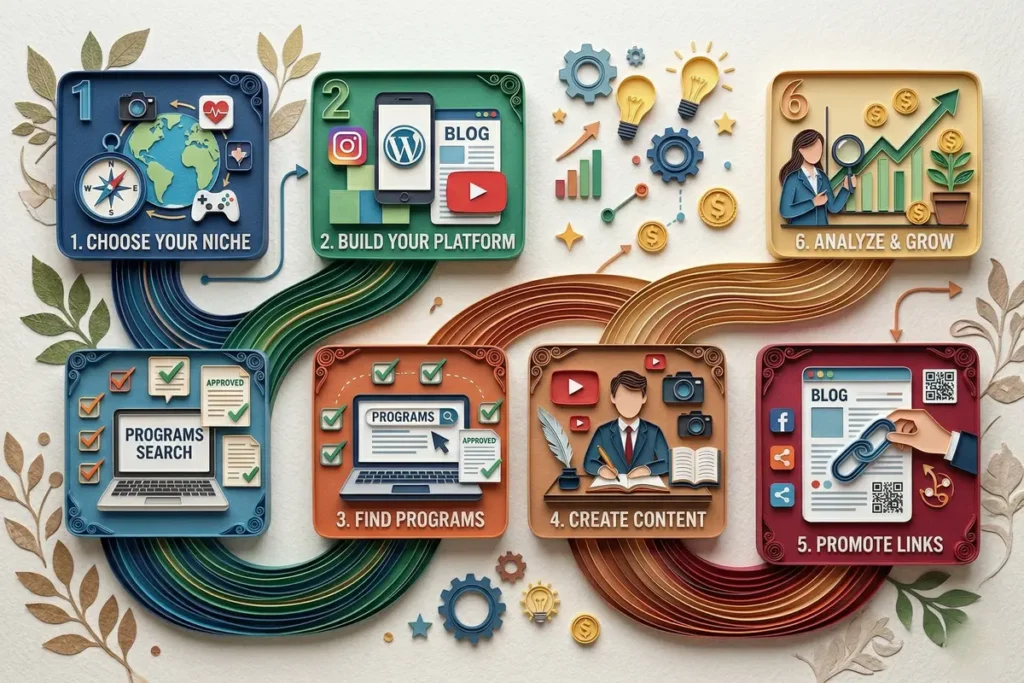
The process is simple:
- Choose a niche.
- Create a website, blog, YouTube channel, or social media page.
- Join affiliate programs related to your niche.
- Create helpful content.
- Add affiliate links naturally inside your content.
- Get traffic from Google, YouTube, or social media.
- Earn commissions when people buy through your links.
The more targeted traffic and trust you build, the higher your earning potential becomes.
Now that you understand the basics, let’s go step by step and see how beginners actually start affiliate marketing from scratch.
Step 1. Choose a Niche
A niche is the main topic you will create content about and promote products in. It helps you target a specific audience instead of trying to reach everyone.
For example, instead of creating content about everything, you focus on one topic like AI tools, fitness, blogging, or personal finance.
Why Is Choosing a Niche Important?
Choosing the right niche helps you build trust, attract the right audience, and grow faster.
Many beginners fail because they keep changing topics every week. One day they write about fitness, the next day about gadgets, and then about finance.
When your niche is clear, both Google and your audience understand what your content is about.
How Does Niche Selection Work?
The best niche usually has three things:
- People are actively searching for it.
- Products are available to promote.
- You can create content about it consistently.
For example, AI tools are popular because people search for them daily, many affiliate programs exist, and there are endless content ideas.
A niche becomes profitable when demand, content opportunities, and monetization work together.
Example
Let’s say you enjoy technology.
Instead of creating random tech content, you choose AI tools for beginners as your niche.
Now your content can focus on:
- Best AI writing tools
- AI image generators
- AI productivity software
- AI tools for students
This makes your website more focused and easier to grow.
Once you choose a niche, you can start promoting products related to it.
For example, in the AI tools niche, you can earn commissions from:
- AI writing software
- AI image generation tools
- SEO tools
- Productivity apps
- SaaS subscriptions
The better your niche matches user problems, the easier it becomes to generate affiliate commissions.
That’s why successful affiliate marketers usually spend more time choosing the right niche before they start creating content.
Common Beginner Mistake
Many beginners choose multiple niches together because they want more earning opportunities.
In reality, this usually slows growth because Google and your audience cannot clearly understand what your content is about.
It’s better to focus on one niche first and expand later.
If you’re unsure whether freelancing or blogging is better for affiliate marketing, this guide will clear everything:
Freelancing vs Blogging — Which One Should You Choose?
Step 2 - Create a Platform
A platform is the place where you create content, build an audience, and share your affiliate links. It acts like your online business where people discover your content and recommendations.
You can use:
- A website or blog
- A YouTube channel
- An Instagram page
- A Facebook page
- A LinkedIn profile
Why Is Creating a Platform Important?
Without a platform, people won’t find your content or affiliate links.
Your platform helps you:
- Build trust
- Grow an audience
- Get traffic
- Share recommendations
- Generate affiliate commissions
The stronger your platform becomes, the easier it is to make money with affiliate marketing.
How Does It Work?
First, choose the platform that matches your skills and content style.
For example:
- If you enjoy writing → Start a blog.
- If you like making videos → Start a YouTube channel.
- If you enjoy short-form content → Use Instagram or TikTok.
Most successful affiliate marketers eventually build a website because it gives them full control over content, SEO, and traffic.
Example
Let’s say you choose the AI tools niche.
You create a blog where you publish articles like:
- Best AI Writing Tools
- Best AI Image Generators
- ChatGPT Alternatives
- AI Tools for Students
People find these articles through Google, read your recommendations, and click your affiliate links.
This is how your platform starts generating traffic and commissions.
Once your platform starts getting visitors, you can earn money through:
- Affiliate links
- Sponsored content
- Display ads
- Digital products
- Email marketing
For example, if someone reads your article about AI tools and purchases a software subscription through your affiliate link, you earn a commission from that sale.
That’s why building your own platform is one of the most important steps in affiliate marketing. It becomes the foundation of your long-term online income.
Beginner Tip
If you’re serious about affiliate marketing, start with a website as early as possible.
Social media platforms can change algorithms anytime, but your website remains a long-term digital asset that you fully control.
Step 3: Join Affiliate Programs
Affiliate programs are platforms or company partnerships that allow you to promote products and earn commissions when someone purchases through your affiliate link.
After joining a program, you receive a unique tracking link that records clicks, sales, and commissions.
Why Is Joining Affiliate Programs Important?
Without affiliate programs, you cannot earn commissions from your content.
These programs connect you with companies that are willing to pay you for bringing customers to their products or services.
The better the product matches your audience, the higher the chances of generating sales and commissions.
How Does It Work?
First, choose affiliate programs related to your niche.
For example:
- Blogging niche → Hosting affiliate programs
- AI niche → AI software affiliate programs
- Fitness niche → Supplement affiliate programs
- Finance niche → Investment or finance tools
After approval, the company gives you a unique affiliate link that you can place inside your blog posts, videos, or social media content.
When someone clicks that link and completes a purchase, you earn a commission.
Example
Let’s say you run a blog about AI tools.
You join an AI software affiliate program and write an article called “Best AI Writing Tools for Beginners.”
Inside the article, you recommend an AI tool using your affiliate link.
A visitor reads your article, clicks the link, purchases the software, and the company pays you a commission for that sale.
This is how affiliate programs help turn content into income.
Different affiliate programs offer different commission models.
Common earning methods include:
- One-time commissions
- Recurring monthly commissions
- Lead generation payouts
- Free trial signup commissions
- Course and digital product sales
Some of the most beginner-friendly affiliate programs include:
- Amazon Associates – Easy approval and millions of products.
- ShareASale – Thousands of brands across different niches.
- ClickBank – High commissions and beginner-friendly signup process.
- PartnerStack – Popular for SaaS and AI software affiliate programs.
Many successful affiliate marketers earn recurring income by promoting software and subscription-based tools because one customer can generate commissions for months instead of just one sale.
Step 4: Find Topics People Are Searching For
Finding topics people are searching for means discovering the exact questions, problems, and keywords your target audience is searching on Google, YouTube, and other platforms.
This process is called keyword research, and it helps you create content that people actually want to read.
Why Is It Important?
Creating content without keyword research is like uploading videos or writing articles blindly.
If nobody is searching for your topic, getting traffic becomes very difficult.
Keyword research helps you:
- Find content ideas
- Understand user intent
- Get Google traffic
- Target buyer-focused keywords
- Increase affiliate commissions
The better your keyword selection, the higher your chances of getting visitors and sales.
How Does It Work?
First, think about what your audience wants.
Then use keyword research tools to find related searches.
Popular tools include:
- Google Keyword Planner
- Ahrefs
- Semrush
- Ubersuggest
- KWFinder
For example, if your niche is AI tools, you might find keywords like:
- Best AI writing tools
- ChatGPT alternatives
- AI tools for students
- Best free AI tools
These keywords become your future content topics.
Example
Let’s say your niche is blogging.
Instead of writing random articles, you find keywords people are already searching for, such as:
- How to start a blog
- Best web hosting for beginners
- Blogging mistakes to avoid
- How to make money blogging
Now you are creating content based on real demand instead of guessing topics.
This gives your content a much higher chance of ranking and getting traffic.
Why Buyer Keywords Matter
Not all keywords generate affiliate commissions.
For example:
“What is web hosting?” usually attracts people looking for information.
But “Best web hosting for beginners” attracts people who are much closer to making a purchase.
That’s why successful affiliate marketers focus heavily on buyer-intent keywords instead of only targeting high search volume.
Step 5: Create Helpful Content
Helpful content is content that solves a problem, answers a question, or helps people make better decisions before buying a product.
In affiliate marketing, content is what brings visitors, builds trust, and generates affiliate commissions. Without content, people have no reason to click your affiliate links. (locationrebel.com)
Why Is It Important?
After reviewing affiliate websites across different industries, one common pattern appears repeatedly:
The sites generating the most affiliate revenue usually publish detailed content that genuinely helps users make decisions instead of aggressively pushing products..
People don’t buy products because they see a random affiliate link. They buy because your content helps them understand a problem and find the right solution.
Helpful content helps you:
- Build audience trust
- Get Google traffic
- Increase affiliate clicks
- Improve conversions
- Grow long-term income
Successful affiliate marketers focus on helping first and selling second. (pwskills.com)
How Does It Work?
First, find a topic people are searching for.
Then create content that gives useful answers and naturally recommends products when needed.
Some of the best affiliate content types include:
- Product reviews
- Tutorials
- Comparison articles
- Beginner guides
- Best tools lists
- Case studies
For example, instead of saying “Buy this SEO tool,” explain how the tool solves a specific problem and show real use cases. (jasper.ai)
Example
Let’s say your niche is AI tools.
You write an article called:
“Best AI Writing Tools for Beginners”
Inside the article, you compare different tools, explain their features, show pros and cons, and help readers choose the right option.
Now your affiliate links feel like recommendations instead of advertisements.
This builds trust and increases the chances of earning commissions.
Helpful content generates income when visitors trust your recommendations and take action through your affiliate links.
For example, you can earn commissions from:
- Product reviews
- Software recommendations
- Comparison posts
- Buying guides
- Tutorial articles
Many affiliate marketers make the most money from review posts, comparison articles, and beginner guides because these content types attract users who are already close to making a purchase. (mattmcwilliams.com)
The better your content helps people, the easier it becomes to generate traffic, clicks, and affiliate commissions.
Step 6: Learn Basic SEO
SEO (Search Engine Optimisation) is the process of improving your content so that it can rank higher on Google and bring free organic traffic to your website. Simply put, SEO helps people find your content when they search for related topics online.
Why Is SEO Important?
SEO is one of the most important skills in affiliate marketing because traffic is what generates clicks and commissions.
Without traffic, even the best affiliate content usually won’t make money.
SEO helps you:
- Get free Google traffic
- Reach people already searching for solutions
- Build long-term traffic
- Increase affiliate clicks
- Grow passive income over time
Many successful affiliate websites get most of their traffic from Google instead of paid ads.
When analyzing affiliate websites that rank well on Google, most of them have one thing in common:
They consistently publish helpful content around related topics instead of relying on a few random articles.
How Does It Work?
SEO works by helping Google understand your content and show it to the right people.
Some basic SEO areas include:
- Keyword research
- Optimized titles and headings
- Internal linking
- High-quality content
- Fast website speed
- Mobile-friendly design
For example, if someone searches “Best AI Writing Tools”, Google tries to show the most relevant and helpful content on that topic. Good SEO increases your chances of appearing in those search results.
Example
Let’s say you publish an article called:
“Best Web Hosting for Beginners”
Without SEO, that article may never appear on Google.
But if you properly optimize the keyword, headings, content structure, and user experience, Google can start ranking your article for related searches.
As your rankings improve, more people find your content, click your affiliate links, and potentially purchase through your recommendations.
This is how SEO turns content into traffic and traffic into affiliate income.
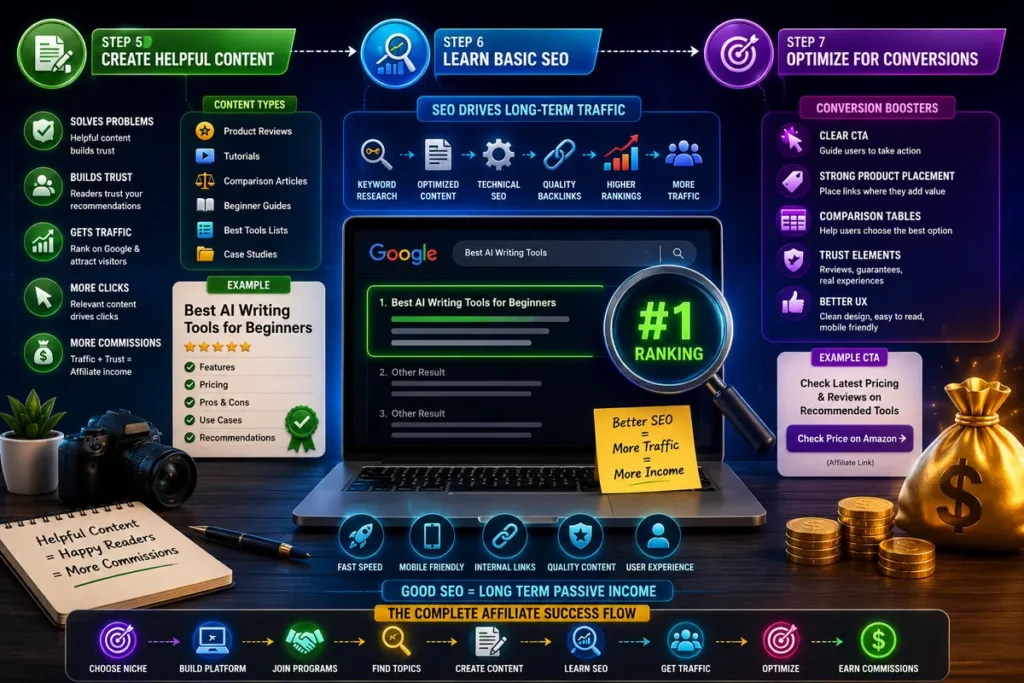
SEO directly affects your affiliate earnings because higher rankings usually bring more targeted visitors.
For example:
- More rankings → More traffic
- More traffic → More clicks
- More clicks → More commissions
This is why many affiliate marketers focus heavily on SEO. A single article ranking on Google’s first page can generate traffic and affiliate commissions for months or even years without running ads.
You can learn more in our guide on how to write SEO-friendly blog posts].
Step 7: Optimize for Conversions
Conversion optimization means improving your content and website so that more visitors click your affiliate links and take action, such as buying a product or signing up for a service.
Getting traffic is important, but conversions are what actually generate affiliate income. (leaddyno.com)
Why Is It Important?
Many beginners focus only on getting traffic.
The problem is that traffic alone doesn’t make money.
If 1,000 people visit your article but nobody clicks your affiliate links, you earn nothing.
Conversion optimization helps you:
- Increase affiliate clicks
- Improve sales
- Build trust
- Earn more from existing traffic
- Grow revenue without needing more visitors
According to affiliate marketing studies, improving conversions can significantly increase earnings even without increasing traffic. (pressidium.com)
How Does It Work?
Conversion optimization is about making it easier for visitors to trust your recommendations and take action.
Some common methods include:
- Clear call-to-action buttons
- Honest product reviews
- Comparison tables
- Pros and cons sections
- Real examples and screenshots
- Faster website speed
For example, instead of simply adding an affiliate link, explain why the product is useful and who it is best for.
This helps visitors make decisions more confidently. (impact.com)
Example
Let’s say you write an article called:
“Best AI Writing Tools for Beginners.”
Instead of only listing tools, you add:
- Features
- Pricing
- Pros and cons
- Personal recommendations
- Comparison tables
Now readers can easily compare options and choose the right tool.
This usually leads to more affiliate clicks and higher conversions because the content feels helpful rather than promotional.
Better conversions mean more income from the same amount of traffic.
For example:
- 1,000 visitors + poor optimization = few commissions
- 1,000 visitors + strong optimization = more commissions
That’s why experienced affiliate marketers don’t just focus on getting traffic. They also improve content, user experience, trust signals, and calls-to-action to increase earnings from every visitor.
Even small conversion improvements can make a big difference in affiliate revenue over time. (optimonk.com)
Why Is SEO Important for Affiliate Marketing Success?
SEO is important for affiliate marketing because it generates consistent, long-term traffic without paying for every visitor.
Unlike paid advertising, SEO traffic can continue arriving long after content is published.
SEO Creates Sustainable Traffic
According to affiliate SEO experts, ranking improvements can significantly increase clicks and conversions.
For example, a product review ranking on page one of Google may attract traffic for years.
SEO Helps Build Trust
Users often trust organic search results more than advertisements.
This trust can improve affiliate conversions.
SEO Content Types That Work Best
Popular affiliate SEO content includes:
- Product reviews
- Comparison posts
- Best-of lists
- Tutorials
- Buying guides
What Type of Content Works Best for Affiliate Marketing?
The best affiliate marketing content is content that helps people solve a problem before recommending a product. People trust useful advice more than direct sales pitches, which is why helpful content usually gets more clicks and conversions. (ahrefs.com)
- Product Reviews – Help readers understand whether a product is worth buying and who it is best for.
- Comparison Articles – Compare two products like Ahrefs vs Semrush or Bluehost vs Hostinger to help users make better decisions.
- Tutorials and Guides – Teach people how to do something while naturally recommending useful tools and products.
- Best Tools Lists – Articles like Best AI Writing Tools for Beginners attract users who are already looking for recommendations.
- Case Studies – Show real results, experiences, and practical examples to build trust with readers.
- Email Marketing Content – Keeps visitors engaged and helps build trust before they decide to buy something.
For example, if you write a guide on how to start a blog, you can naturally recommend hosting services, SEO tools, and blogging resources inside the content. This feels helpful instead of promotional.
The simple rule is: Help first, recommend second. The more useful your content is, the easier it becomes to build trust and generate affiliate commissions. (ahrefs.com)
You can also read our guide on [how to build an email list from scratch] to learn how email marketing helps increase affiliate sales over time.
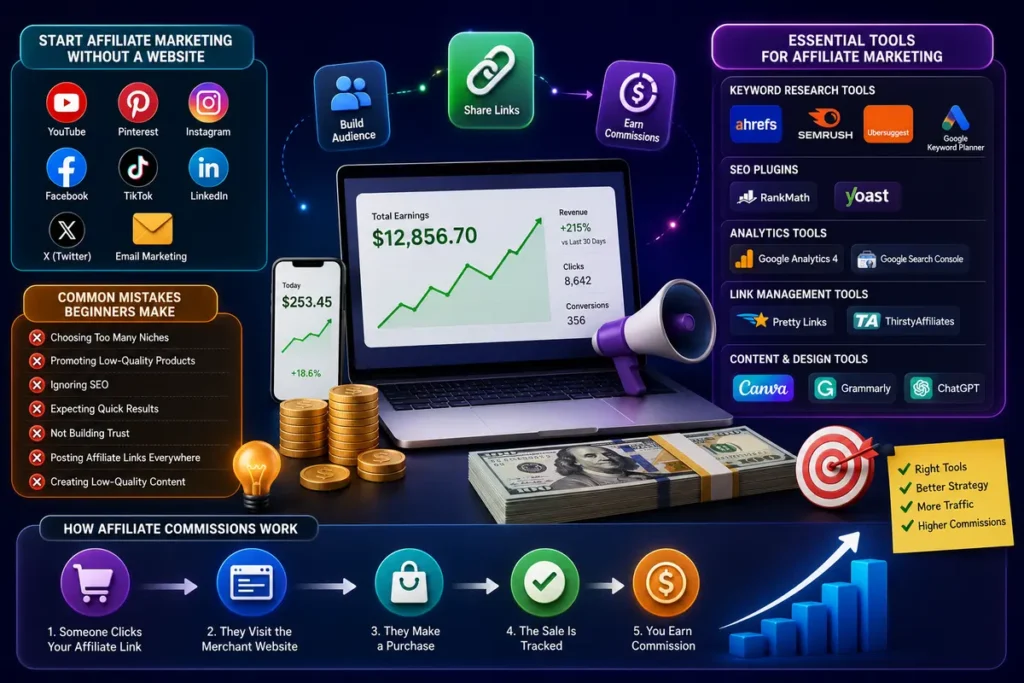
How Can You Start Affiliate Marketing Without a Website?
You don’t necessarily need a website to start affiliate marketing. Many beginners start by promoting affiliate products through social media, YouTube, Pinterest, or email marketing before building their own website. The goal is simple: create helpful content, attract an audience, and recommend relevant products. (shopify.com)
- YouTube – Create tutorials, reviews, and product demonstrations, then add affiliate links in your video descriptions. YouTube is one of the most popular affiliate marketing platforms today.
- Pinterest – Pinterest works like a visual search engine where people discover ideas, products, and solutions through pins. Many affiliates drive traffic directly to affiliate offers using Pinterest content.
- Instagram – Share reels, carousels, stories, and product recommendations to build an audience and promote affiliate products naturally.
- Facebook – Use Facebook pages, groups, and content posts to share helpful information and affiliate recommendations.
- TikTok – Short videos can quickly reach large audiences and help promote products through tutorials, tips, and demonstrations.
- LinkedIn – Works well for promoting business tools, SaaS products, AI tools, and professional services.
- X (Twitter) – Useful for sharing quick tips, content updates, product recommendations, and affiliate offers.
- Email Marketing – Helps you build a direct relationship with your audience instead of depending completely on Google or social media algorithms. Many successful affiliates use email lists to increase clicks and affiliate sales over time.
If you want to grow faster, you should learn how to increase blog traffic fast.
For example, if you create AI tool tutorials on YouTube, you can place affiliate links in the description and earn commissions when viewers purchase through those links. This is one of the most common ways beginners start affiliate marketing without owning a website.
What Are the Biggest Affiliate Marketing Mistakes Beginners Make?
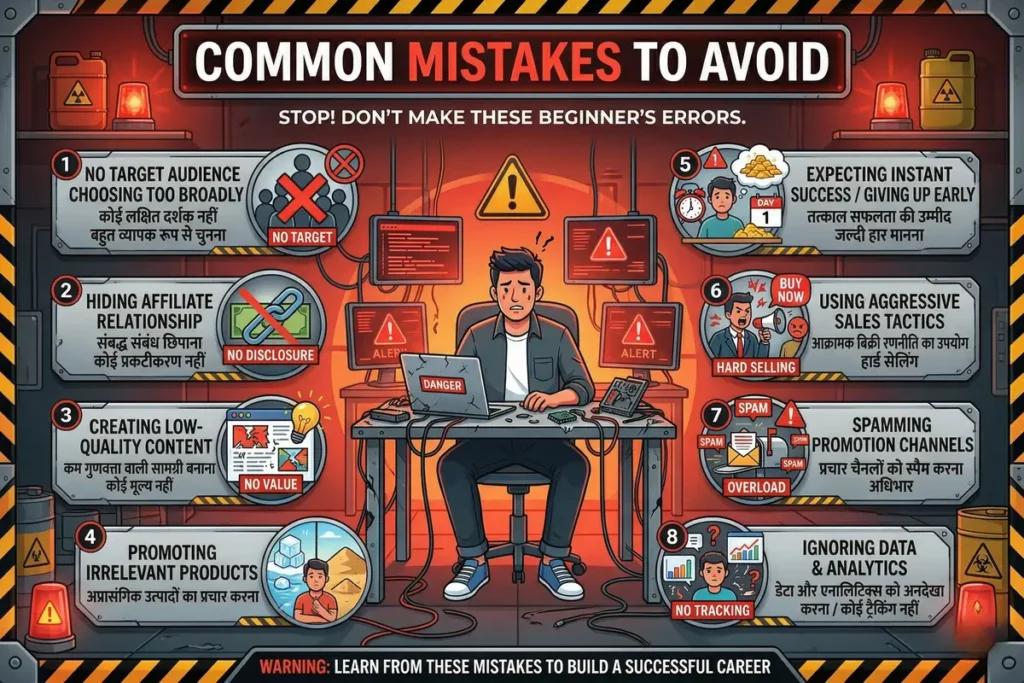
Many beginners fail in affiliate marketing not because the model doesn’t work, but because they make common mistakes in the beginning. Avoiding these mistakes can save you months of wasted time and help you grow faster.
- Choosing Too Many Niches – Many beginners try to target fitness, tech, finance, and AI at the same time. Focusing on one niche helps build trust and authority faster.
- Promoting Low-Quality Products – Recommending bad products may earn short-term commissions, but it can quickly damage your audience’s trust.
- Ignoring SEO – Without traffic, affiliate links rarely generate sales. SEO helps bring free visitors from Google and remains one of the most valuable affiliate marketing skills. (ahrefs.com)
- Expecting Quick Results – Affiliate marketing is not a get-rich-quick business. Most successful affiliates spend months creating content and building traffic before earning a consistent income.
- Not Building Trust – People buy from creators they trust. Honest reviews, real experiences, and transparent recommendations usually perform much better than aggressive selling.
- Posting Affiliate Links Everywhere – Spamming affiliate links without providing value often reduces clicks and makes your content look promotional.
- Creating Low-Quality Content – Thin content rarely ranks on Google or builds audience trust. Helpful content usually generates better traffic and conversions over time.
The biggest lesson is simple: Focus on helping people first and commissions second. Most successful affiliate marketers earn more because they build trust, solve problems, and recommend products naturally instead of chasing quick sales. (shopify.com)
You should also read our guide on [common blogging mistakes beginners make] to avoid mistakes that slow down website growth and traffic.
What Tools Do Beginners Need for Affiliate Marketing?
Affiliate marketing tools help you find keywords, improve SEO, track traffic, manage affiliate links, and create content more efficiently. You don’t need expensive tools in the beginning, but the right tools can save a lot of time and help you grow faster.
Keyword Research Tools
- Ahrefs – Helps you find keyword ideas, analyze competitors, check search volume, and discover ranking opportunities. (ahrefs.com)
- Semrush – Useful for keyword research, competitor analysis, SEO audits, and content planning. (semrush.com)
- Ubersuggest – Beginner-friendly keyword research tool that provides search volume, SEO difficulty, and content ideas. (neilpatel.com)
- Google Keyword Planner – Free Google tool that helps discover keywords and estimate search demand. (support.google.com)
SEO Plugins
- Rank Math – Helps optimize blog posts, improve on-page SEO, add schema markup, and track SEO scores directly inside WordPress. (rankmath.com)
- Yoast SEO – Popular WordPress SEO plugin that helps optimize content, meta tags, readability, and search engine visibility. (yoast.com)
Analytics Tools & Link Management Tools
Analytics Tools
- Google Analytics 4 (GA4) – Tracks website traffic, user behavior, page performance, and conversions. (analytics.google.com)
- Google Search Console – Shows which keywords bring traffic from Google and helps monitor search performance and indexing issues. (search.google.com)
Link Management Tools
- Pretty Links – Helps shorten, organize, and track affiliate links while making them look cleaner and more professional. (prettylinks.com)
- ThirstyAffiliates – Makes affiliate link management easier by organizing links, cloaking URLs, and tracking clicks. (thirstyaffiliates.com)
AI Content Tools
- ChatGPT – Helps generate content ideas, outlines, research assistance, and content drafts faster.
- Jasper AI – Useful for creating marketing content, blog drafts, and product-focused copy. (jasper.ai)
- Claude AI – Helpful for long-form writing, content improvement, and research-based content creation.
You can also read our guide on [best AI tools for content creation] to discover more tools for blogging and affiliate marketing.
How Long Does It Take to Earn Your First Affiliate Commission?
Time Period | What Usually Happens |
Month 1–3 | Learning affiliate marketing, choosing a niche, and publishing content. |
Month 3–6 | Getting first traffic, clicks, and sometimes your first commission. |
Month 6–12 | More content starts ranking on Google and traffic grows steadily. |
12+ Months | Potential for consistent affiliate commissions and recurring income. |
Most beginners don’t earn money immediately because affiliate marketing takes time, traffic, and trust. If you’re using SEO, it can take a few months before your articles start ranking and bringing visitors.
The good news is that affiliate marketing rewards consistency. One article rarely changes anything, but publishing helpful content regularly can slowly build traffic, trust, and commissions over time.
Can You Start Affiliate Marketing With No Money?
Yes, you can start affiliate marketing with little or no money by using free platforms and free traffic sources. Many successful affiliate marketers started without investing heavily in the beginning and slowly scaled as they grew.
- Free Blogging Platforms – Platforms like Medium and Blogger allow you to publish content and share affiliate recommendations without creating a website.
- YouTube – You can create tutorials, reviews, and educational videos, then add affiliate links in the video description. (shopify.com)
- Social Media – Platforms like Instagram, Facebook, TikTok, and X help you build an audience and promote affiliate products through content.
- Medium – A free publishing platform where you can write articles, share knowledge, and attract readers interested in your niche.
- LinkedIn Articles – Useful for promoting business tools, SaaS products, AI software, and professional services through long-form content.
Even though you can start for free, investing later in a domain name, web hosting, and SEO tools can help you grow faster and build a long-term affiliate business.
Many successful affiliate marketers started with free platforms first and upgraded their tools only after generating their first commissions. (authorityhacker.com)
What Should Beginners Do Next?
The biggest mistake beginners make is spending months watching videos and reading guides without taking action. The fastest way to learn affiliate marketing is by actually starting.
Affiliate Marketing Beginner Roadmap
Choose a Niche↓
Build a Platform↓
Join Affiliate Programs↓
Keyword Research↓
Create Helpful Content↓
Learn SEO↓
Get Traffic↓
Optimize Conversions↓
Earn Your First Commission
Most successful affiliate marketers follow this exact process.
The biggest mistake beginners make is trying to skip steps and earn commissions before building content, traffic, and trust.
Your First 30-Day Action Plan
Your First 30-Day Action Plan
- Choose One Niche – Pick a topic you can create content about consistently without getting bored.
- Join One Affiliate Program – Start with a beginner-friendly program like Amazon Associates, ShareASale, or PartnerStack.
- Publish Your First Content Piece – Create your first blog post, video, review, or tutorial instead of waiting for perfection.
- Create a Content Calendar – Plan future content ideas so you stay consistent and avoid running out of topics.
- Learn Basic SEO – Understand how keywords, content optimization, and Google rankings work.
- Track Clicks and Traffic – Monitor where visitors are coming from and which content performs best.
- Publish Consistently – Focus on creating helpful content regularly instead of expecting instant results.
Focus on Traffic First
In the beginning, your main goal should be getting traffic. Without visitors, affiliate links cannot generate clicks or commissions.
Track Your Results
Keep an eye on:
- Click-Through Rate (CTR) – Shows how many people click your affiliate links.
- Traffic Growth – Helps measure whether your content is attracting more visitors over time.
- Keyword Rankings – Shows which articles are improving in Google search results.
- Affiliate Earnings – Helps identify which content and products generate the most commissions.
The simple rule is: Take action, stay consistent, and improve with every piece of content. Most successful affiliate marketers grow because they keep publishing while others keep waiting for the perfect time to start. (ahrefs.com)
How Long Does It Take to Succeed in Affiliate Marketing?
Affiliate marketing is a long-term business model, not a quick money scheme. Most successful affiliates spend months creating content, learning SEO, and building traffic before seeing consistent commissions. The people who stay consistent usually see the best results over time. (ahrefs.com)
Realistic Expectation for Beginners
Based on patterns seen across affiliate websites and content-driven businesses, most beginners should expect a learning phase before seeing meaningful commissions.
The first goal should not be making money immediately.
The first goal should be publishing content, building traffic, learning SEO, and improving with every piece of content.
This long-term mindset is often what separates successful affiliate marketers from those who quit too early.
FAQs
Q1. Can beginners really earn from affiliate marketing?
Yes, beginners can earn from affiliate marketing, but success depends on consistency and strategy.
Q2. How long does it take to earn money?
Affiliate marketing usually takes a few months to show results. Most beginners start seeing small earnings after 3-6 months.
Q3. Do I need a blog for affiliate marketing?
A blog is highly recommended because it helps you build long-term traffic and trust. Social media can help, but a blog gives more control.
Q4. Is affiliate marketing free to start?
You can start with a low investment, but having a blog increases your chances of success.
Q5. Which niche is best for affiliate marketing?
The best niche is one where you can consistently create content and help your audience solve problems.
Conclusion
At last now i think you got your answer what is affiliate marketing and how Affiliate Marketing for Beginners works, it is so easy to start and best for Online earning.
It is not a shortcut to quick money, but it is one of the most powerful ways to build long-term online income.
If you focus on:
- Helping people
- Creating valuable content
- Building trust
You can build a strong foundation and grow your income over time.
Start simple, stay consistent, and focus on value – results will come guaranteed.
💬 What niche are you choosing for affiliate marketing? Comment below, and I’ll guide you.
Written by
Pratap Keshari Panda – Digital marketer, blogger, and online business educator focused on SEO, affiliate marketing, AI-powered content creation, and digital growth strategies for beginners.
Reviewed by
Editorial Review Team – Specialists in SEO, content marketing, affiliate monetization, and digital publishing best practices.

 350+ Blog Guides Published


6 Comments
[…] Affiliate marketing strategies → Explain ways to earn online income […]
[…] Affiliate marketing allows bloggers and creators to earn commissions by recommending useful products… […]
[…] you plan to earn through affiliate marketing, building an email list will help you promote affiliate products more […]
[…] If you are interested in Affiliate Marketing, then click here. […]
[…] you want to earn online through marketing, learning affiliate marketing skills can give you a strong starting […]
[…] You can understand step-by-step how it works: […]