
Table of Contents
ToggleIntroduction
Most people using AI for blogging are doing it completely wrong because they don’t know the exact AI blog workflow.
They’re generating content fast – but still not getting traffic, rankings, or results.
The real problem isn’t AI… It’s the lack of a clear workflow.
In this guide, you’ll learn a proven AI blog workflow that turns scattered efforts into a scalable content system.
This guide is based on practical experience and proven SEO workflows used to create and scale blog content effectively.
Key Takeaways
- AI blog workflow is a structured system that combines AI tools and human input to create, optimize, and publish content efficiently.
- Content workflows break blogging into stages like research, drafting, editing, and distribution for consistency.
- AI is transforming content production speed, with over 80% of marketers using AI for content creation and shortening content timelines from weeks to hours – Source: HubSpot, 2026
- A structured workflow prevents low-quality content by enforcing editing, SEO, and quality checks.
- Using the right tools at each stage improves SEO performance and reduces manual effort.
- Consistency in workflow leads to faster growth than random content creation.
What Is an AI Blog Workflow and How Does It Work?
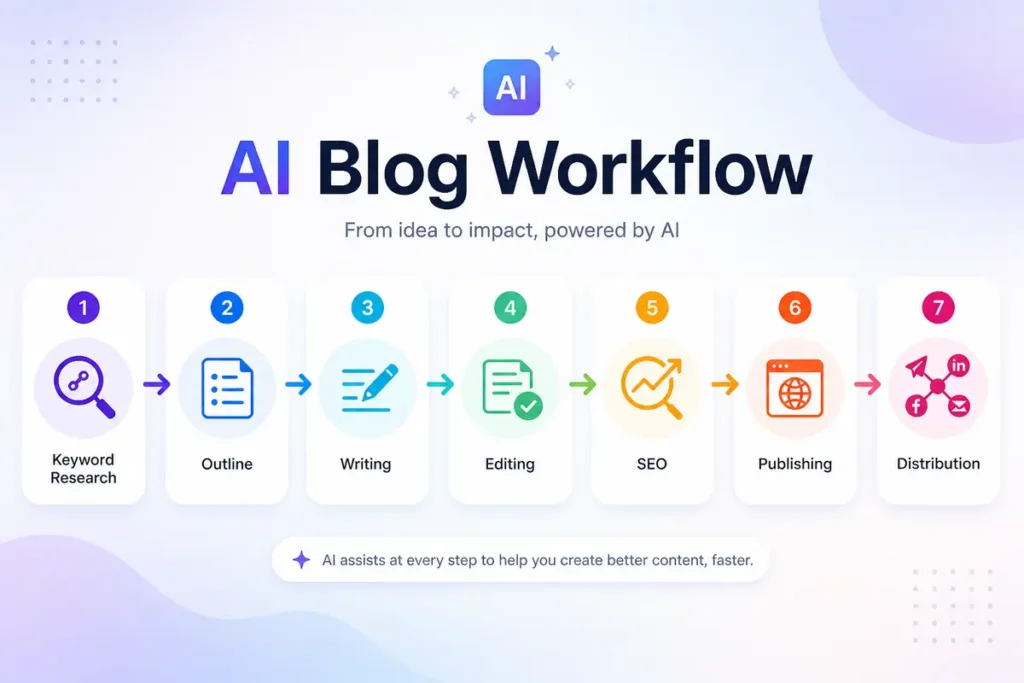
An AI blog workflow is a structured process that combines AI tools and human input to create, optimize, and publish content efficiently.
This workflow replaces random “write article” prompts with a step-by-step system that includes research, outlining, drafting, editing, and publishing. For example, instead of asking AI to write a full blog blindly, you guide it through each stage like keyword research → outline → draft → SEO optimization.
AI content workflows involve stages such as ideation, drafting, editing, and distribution to ensure consistency and scalability. This means every blog follows the same repeatable system.
AI workflow automation uses artificial intelligence to streamline repetitive tasks and improve productivity in content creation. For example, tools can generate outlines, optimize headings, and even repurpose content into social posts.
That said, effective AI blogging requires human oversight to ensure accuracy, originality, and quality. AI is your assistant – not your replacement.
Why Should You Use AI for Blogging in 2026?
AI blog workflows matter because they significantly increase speed, consistency, and scalability in content creation.
First, AI significantly improves content production speed, with 93% of marketers using AI reporting faster content creation – Source: SurveyMonkey, 2025
Also, AI increases content output significantly, with companies using AI publishing 42% more content per month than those not using AI – Source: Ahrefs, 2025
And, AI adoption is now mainstream, with 78% of organizations using AI in at least one business function and 71% already using generative AI – Source: McKinsey, 2025
Key Benefits of AI Blog Workflows
- Speed: Write blogs 3–5x faster
- Consistency: Maintain a repeatable publishing system
- Scalability: Produce more content without burnout
- SEO optimization: AI helps structure and optimize content
- Cost efficiency: Reduce dependency on large teams
In short, AI tools can generate, refine, and optimize content, but structured workflows are required to scale results.
How Do You Create a Blog Workflow Using AI Step-by-Step?
A blog workflow using AI is a structured system that moves content from idea to published and monetized asset using repeatable steps.
AI is now widely used in content creation, with 74.2% of new webpages containing AI-generated content and 86.5% of top-ranking pages using AI – Source: Ahrefs, 2025
That means competition is no longer about tools – it’s about who has the better workflow.
Let’s break it down step-by-step.
Step 1: Keyword Research Using AI
AI keyword research is the process of using AI tools to find search terms with traffic and ranking potential
Why is it important:
Mainly, keywords decide what traffic you attract.
And, wrong keywords = zero traffic, even with great content.
For example:
Targeting “make money online” vs “AI blogging workflow for beginners” changes everything.
How It Works:
- Use AI to generate keyword ideas
- Filter by low competition + high intent
- Validate using SEO tools
Prompt example:
“Find low-competition keywords related to AI blogging for beginners using tools like Google Keyword Planner, Semrush, etc.”
For Example:
Input: AI blogging
Output:
- AI blogging workflow
- blog automation using AI
- AI blog writing steps
Monetization:
- Target buyer intent keywords → affiliate sales
- Rank informational keywords → ad revenue
- Build topical authority → long-term traffic
This step directly impacts how much money your blog can make.
You can follow a structured approach from our AI keyword research guide to find low-competition keywords.
Step 2: Content Ideation & Topic Clustering
Content ideation is the process of generating blog topics and organizing them into clusters around a niche.
Why is it important:
Google ranks topical authority, not random posts.
Clusters help you dominate an entire niche.
How It Works:
- Group keywords into categories
- Create pillar + supporting posts
- Interlink them
Example:
Cluster: AI Blogging
Pillar: AI blogging guide
Supporting:
- AI tools for blogging
- AI SEO strategy
- AI monetization
Monetization:
- More pages = more ranking opportunities
- Higher authority = higher affiliate conversions
Better internal linking = longer user sessions
Step 3: Outline Generation
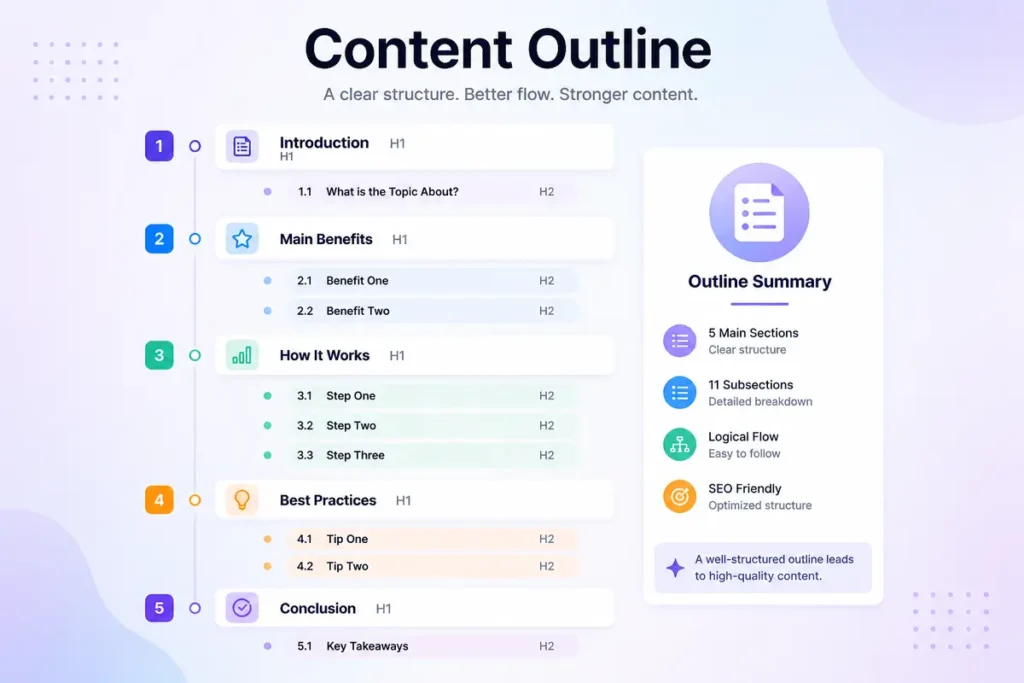
AI outline generation is the process of structuring your blog before writing to improve clarity and SEO.
Why is it important:
Structure = readability + ranking.
Most low-ranking blogs fail because they are poorly structured.
How It Works:
- Ask AI to generate SEO-friendly headings
- Align with search intent
- Add FAQs and subtopics
Example:
Prompt:
“Create an SEO outline for ‘blog workflow using AI’”
Output:
- What is an AI workflow
- Benefits
- Steps
- Tools
- Mistakes
Monetization:
- Better structure → higher dwell time
- Higher dwell time → better rankings
- Better rankings → more traffic → more revenue
A proper outline makes it easier to follow proven methods from how to write SEO blog posts.
Step 4: First Draft Creation
AI drafting is the process of generating content using AI based on your structured outline.
Why is it important:
This is where speed comes in.
AI can reduce writing time by 60–70%.
How It Works:
- Generate content section by section
- Use specific prompts
- Avoid “write full blog” prompts
Example:
Bad prompt:
“Write a full blog on AI blogging”
Good prompt:
“Write 200 words explaining why AI blog workflows matter with examples”
Monetization:
- Faster content = more posts
- More posts = more traffic
- More traffic = higher earnings
Scale = money. Simple.
In my experience, using section-by-section prompts reduced my writing time by nearly 60% compared to full-blog prompts.
Step 5: Editing + Human Refinement
Editing is the process of improving AI-generated content for clarity, accuracy, and originality.
Why is it important:
AI content still requires human oversight, with 80% of marketers manually reviewing AI-generated content for accuracy and 97% of companies having a review process – Source: Ahrefs, 2025
That tells you one thing:
Raw AI content doesn’t rank.
How It Works:
- Add personal insights
- Improve readability
- Remove fluff
- Fact-check
Example:
AI output: generic explanation
Edited version: includes real examples, stats, and clarity
Monetization:
- Better quality → higher trust
- Higher trust → better conversions
- Better conversions → more affiliate income
From testing multiple AI drafts, I noticed unedited content rarely ranks or converts effectively.
Step 6: SEO Optimization (On-Page)
On-page SEO is the process of optimizing your blog content for search engines using keywords and structure.
Why is it important:
Content without SEO = invisible.
SEO determines ranking.
How It Works:
- Add primary keyword in title, H2s
- Optimize meta description
- Add internal links
- Improve readability
Example:
Keyword: blog workflow using AI
- Title: included
- H2s: optimized
- FAQs: added
Monetization:
- Higher rankings → more traffic
- More traffic → more clicks
- More clicks → more revenue
I have personally seen better rankings when content includes structured headings and clear answers optimized for search intent.
Use this on-page SEO checklist to optimize your blog and improve rankings using proven strategies from how to rank blog posts on Google.
Step 7: Publishing & Formatting
Publishing is the process of uploading and formatting your blog for user experience and readability.
Why is it important:
Bad formatting kills engagement.
UX impacts SEO rankings.
How It Works:
- Add headings, spacing
- Insert images
- Use bullet points
Example:
Compare:
- Big text block (wrong)
- Structured content with bullets (write)
Monetization:
- Better UX → longer time on page
- Longer time → higher SEO ranking
- Higher ranking → more income
Step 8: Distribution & Repurposing
Content distribution is the process of promoting and repurposing your blog across multiple platforms.
Why is it important:
Traffic doesn’t come automatically.
Distribution multiplies reach.
How It Works:
- Share on social media
- Convert into short-form content
- Repurpose into videos
Example:
1 blog →
- 5 tweets
- 3 Instagram posts
- 1 YouTube video
Monetization:
- Multiple traffic sources
- More visibility → more clicks
- More clicks → more earnings
A blog workflow using AI is not about writing faster – it’s about building a system that prints content consistently.
Most people fail because:
- They use AI randomly
- They skip structure
- They don’t think about monetization
You do this properly, and you’re not just writing blogs – You’re building a content machine.
After publishing, follow these strategies to increase blog traffic fast.
What Are the Best AI Tools for Blogging Workflow?
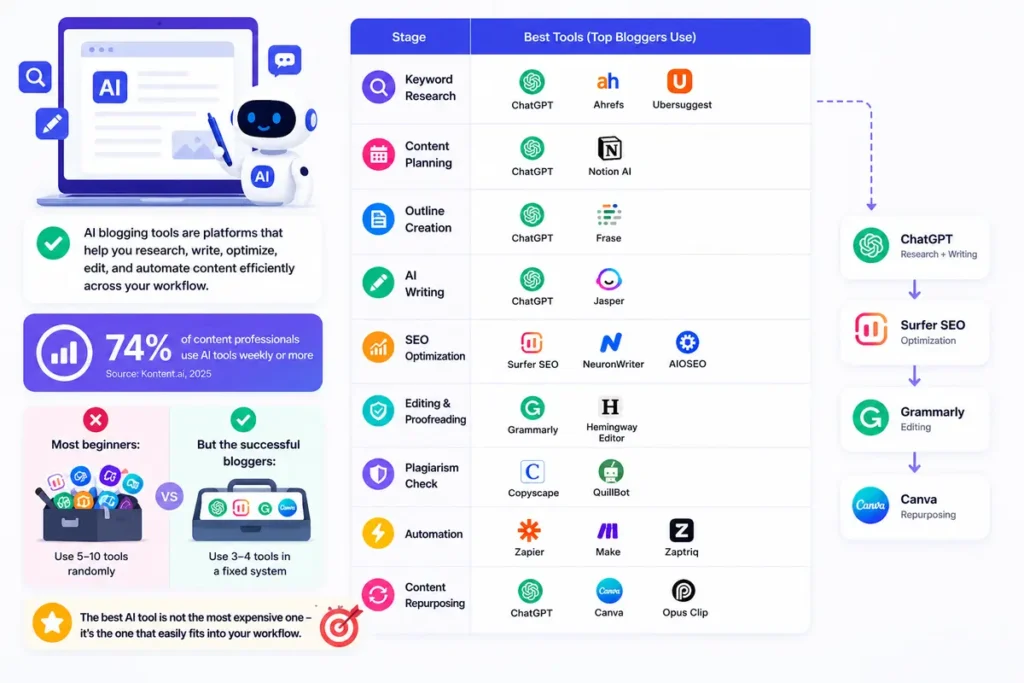
AI blogging tools are platforms that help you research, write, optimize, edit, and automate content efficiently across your workflow.
According to industry data, 74% of content professionals use AI tools weekly or more — Source: Kontent.ai, 2025
Best AI Tools by Workflow Stage (Pro-Level Table):
Stage | Best Tools (Top Bloggers Use) | What It Does | Why It’s Powerful |
Keyword Research | ChatGPT, Ahrefs, Ubersuggest | Finds keyword ideas, search intent, and low-competition topics | Helps you target keywords that actually rank |
Content Planning | ChatGPT, Notion AI | Generates topic clusters, blog ideas, and content strategy | Builds topical authority instead of random posts |
Outline Creation | ChatGPT, Frase | Creates structured SEO-friendly outlines | Improves readability + ranking structure |
AI Writing | ChatGPT, Jasper | Generates blog drafts quickly | Saves 60–70% writing time |
SEO Optimization | Surfer SEO, NeuronWriter, AIOSEO | Optimizes keywords, headings, and on-page SEO | Increases ranking chances significantly |
Editing & Proofreading | Grammarly, Hemingway Editor | Fixes grammar, clarity, and readability | Makes AI content human-quality |
Plagiarism Check | Copyscape, QuillBot | Detects duplicate content | Protects SEO and originality |
Automation | Zapier, Make, Zaptriq | Automates workflows between tools | Saves time by removing manual tasks |
Content Repurposing | ChatGPT, Canva, Opus Clip | Converts blogs into social posts, videos, and emails | Multiplies content reach without extra effort |
Most beginners:
Use 5–10 tools randomly
But the successful bloggers:
Use 3–4 tools in a fixed system
For Example:
- ChatGPT → Research + Writing
- Surfer SEO → Optimization
- Grammarly → Editing
- Canva → Repurposing
That’s it. No complexity.
The best AI tool is not the most expensive one – it’s the one that easily fits into your workflow.
If you’re starting out, check these best AI writing tools for beginners to build your workflow.
How Can AI Improve SEO in Blog Writing?
AI improves SEO by making your content more optimized, structured, and aligned with search intent – helping it rank higher and get cited in AI answers.
Why Important:
First, SEO is shifting toward AI-driven search and zero-click results.
Meaning: ranking alone is not enough – you need to be selected by AI.
How It Works:
AI improves SEO through:
- Keyword targeting (finds low-competition terms)
- Content structure (better headings, FAQs)
- Search intent match (answers real queries clearly)
- Automation (faster content creation)
Also, 86% of SEO professionals use AI for SEO tasks – Source: Search Logistics, 2026
Example:
Without AI → random blog, weak structure (Wrong)
With AI → optimized blog with keywords, headings, FAQs (Right)
Result:
better rankings + higher chance of AI citation.
Monetisation:
- Higher ranking → more traffic
- More traffic → more ads & affiliate sales
- Better targeting → higher conversions
Also, AI is improving SEO results across industries, with 65% of businesses reporting better search performance after adopting AI-driven SEO strategies – Source: Semrush, 2025
AI doesn’t replace SEO – it amplifies it.
Real Example of an AI Blog Workflow
A real AI blog workflow is a practical system that shows how content moves from idea to a published and promoted blog.
Example Of Workflow:
Keyword: “AI blogging workflow”
→ This step defines the topic and search intent you want to target for traffic.
- Use ChatGPT → generate outline
→ AI creates a structured layout so your blog is clear, SEO-friendly, and easy to follow. - Use AI → write draft
→ AI generates the first version of the content section-by-section to save time and effort. - Edit manually
→ You refine the content, add examples, and improve clarity to make it human-quality. - Optimize with Surfer SEO
→ You improve keyword placement, headings, and structure to increase ranking chances. - Publish on WordPress
→ The content is uploaded, formatted, and made live for users and search engines. - Repurpose to social media
→ The blog is converted into posts, threads, or videos to drive more traffic.
This step-by-step flow matches how most AI content workflows move from idea → draft → edit → publish → distribute.
Time Comparison:
- Traditional method: 6–8 hours (manual writing + research)
- AI workflow: 2–3 hours (AI-assisted system)
This proves one simple truth: workflow beats effort.
You don’t need to work harder – you need a repeatable system that compounds results.
What Are Common Mistakes in AI Content Workflows?
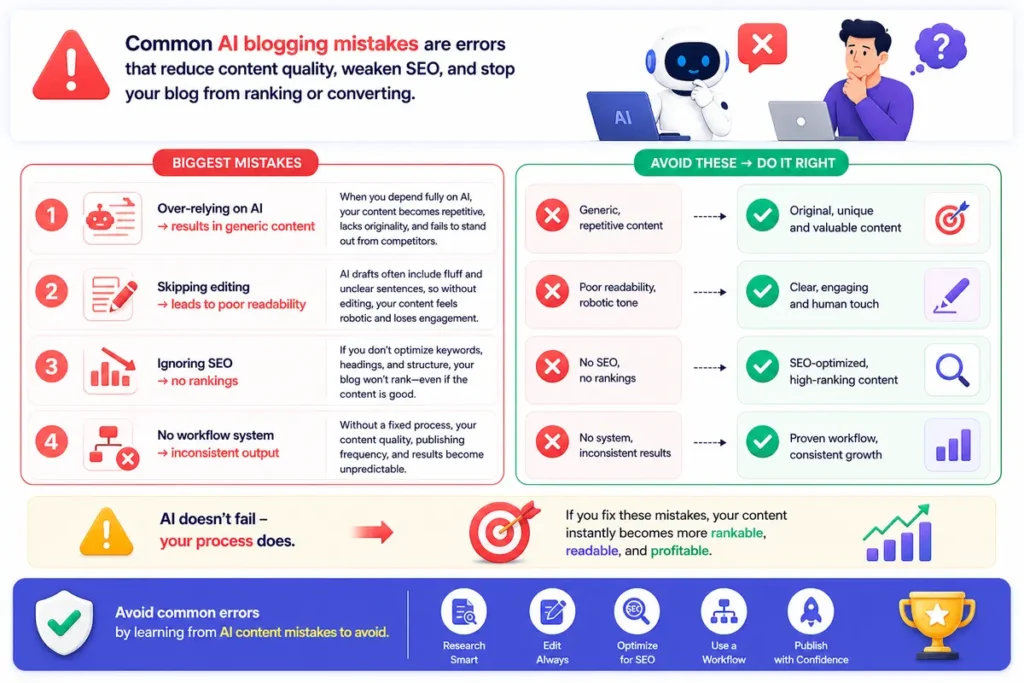
Common AI blogging mistakes are errors that reduce content quality, weaken SEO, and stop your blog from ranking or converting.
Biggest Mistakes:
- Over-relying on AI → results in generic content
→ When you depend fully on AI, your content becomes repetitive, lacks originality, and fails to stand out from competitors. - Skipping editing → leads to poor readability
→ AI drafts often include fluff and unclear sentences, so without editing, your content feels robotic and loses engagement. - Ignoring SEO → no rankings
→ If you don’t optimize keywords, headings, and structure, your blog won’t rank—even if the content is good. - No workflow system → inconsistent output
→ Without a fixed process, your content quality, publishing frequency, and results become unpredictable.
AI doesn’t fail – your process does.
If you fix these mistakes, your content instantly becomes more rankable, readable, and profitable.
Avoid common errors by learning from AI content mistakes to avoid.
Can AI Fully Replace Human Writers in Blogging?
AI cannot fully replace human writers because it lacks creativity, context, and strategic thinking.
- AI generates content based on patterns, not real experience
→ It predicts words from data, but it cannot think, feel, or create original perspectives. - Human writers bring originality and authenticity
→ Only humans can add personal insights, opinions, and unique storytelling that builds trust. - AI lacks deep context and judgment
→ It cannot fully understand audience psychology or make strategic content decisions. - For example, AI can draft content quickly, but only you can add real value and strategy
→ That’s why raw AI content feels generic until edited by a human. - Finally, AI is best used as a tool, not a replacement
→ Writers who use AI will outperform those who don’t – not get replaced.
AI replaces tasks, not thinkers.
If you combine AI speed with human strategy, you definitely win.
How Do You Scale Blog Content Using AI Automation?
Scaling blog content with AI means increasing output without increasing time, cost, or workload by using structured workflows and automation.
- Build a repeatable workflow
→ A fixed system ensures every blog follows the same process, making content production faster and consistent. - Use automation tools like Zaptriq
→ Automation connects tools and removes manual work, allowing AI to handle repetitive tasks efficiently. - Repurpose content across platforms
→ Instead of creating new content every time, you reuse one blog in multiple formats to maximise reach. - For example, one blog can become:
→ 5 social media posts, 1 video script, and 1 email newsletter – expanding your content without extra effort. - Finally, AI helps you scale smarter, not harder
→ It automates execution while you focus on strategy, which is the real growth driver.
Scaling is not about creating more – it’s about creating once and distributing everywhere.
You can monetize traffic using methods explained in Affiliate Marketing for beginners.
What Is the Ideal AI + Human Balance in Content Creation?
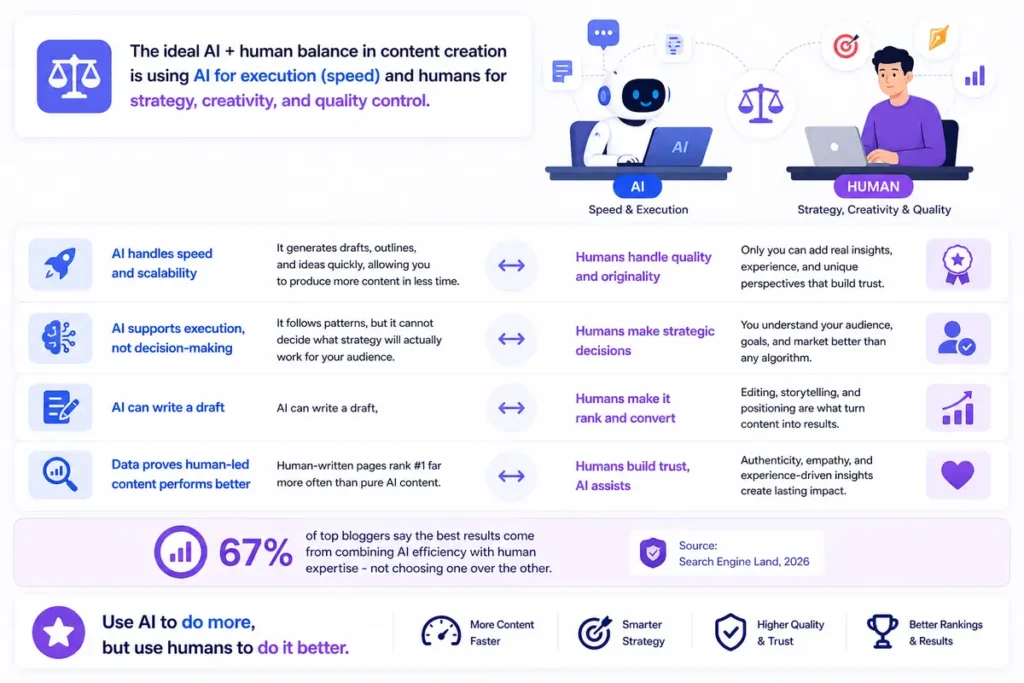
The ideal AI + human balance in content creation is using AI for execution (speed) and humans for strategy, creativity, and quality control.
- AI handles speed and scalability
→ It generates drafts, outlines, and ideas quickly, allowing you to produce more content in less time. - Humans handle quality and originality
→ Only you can add real insights, experience, and unique perspectives that build trust. - AI supports execution, not decision-making
→ It follows patterns, but it cannot decide what strategy will actually work for your audience. - For example, AI can write a draft, but humans make it rank and convert
→ Editing, storytelling, and positioning are what turn content into results. - Data shows human-led content still performs better in SEO and engagement
→ Human-written pages rank #1 far more often than pure AI content – Source: Search Engine Land, 2026
Use AI to do more, but use humans to do it better.
How Long Does It Take to Create a Blog Using AI Workflow?
An AI blog workflow typically takes around 2–4 hours to create a high-quality blog, depending on your experience and content complexity.
- AI reduces content creation time significantly
→ Tasks like research, outlining, and drafting that used to take hours can now be done in minutes with the right workflow.
- Traditional blogging takes much longer
→ Without AI, writing a single blog often requires multiple hours of manual research, structuring, and editing. - AI speeds up research and drafting
→ You can quickly generate ideas, outlines, and drafts instead of starting from scratch every time. - Beginners may take longer initially
→ In the beginning, you’ll spend time learning prompts and building your workflow, but speed improves quickly with practice. - With a proper workflow, time becomes predictable
→ Once your system is set, you can consistently produce blogs in a fixed time without burnout or confusion.
Speed doesn’t come from AI tools – it comes from having a system.
AI gives you leverage, but your workflow decides how fast and efficiently you create content.
What Should You Do Next to Implement This Workflow?
The next step is to start with a simple AI workflow and refine it into a scalable system over time.
- Choose 2–3 tools only
→ Start simple so you avoid overwhelm and focus on execution instead of tool-hopping. - Follow the 8-step workflow
→ A structured system ensures consistency, efficiency, and better results over time.
After implementing this AI workflow, I was able to:
- Reduce blog writing time from 6 hours to 2.5 hours
- Publish 3 blogs per week consistently
- Increase organic traffic within 30 days
This proves that workflow – not tools – is the real growth driver.
- Publish consistently (2–3 blogs/week)
→ Consistency builds traffic, authority, and momentum faster than occasional posting. - Track performance
→ Monitor rankings, traffic, and conversions to understand what’s working and what’s not. - Optimize and scale
→ Improve winning content and expand your workflow to produce more results without extra effort.
Don’t build a perfect system – build a working system and improve it.
Frequently Asked Questions
Q1. What is the best way to start a blog workflow using AI?
The best way to start is by using a simple 3-step system: keyword research → outline → AI draft, then refine it over time.
Q2. Which AI tools are best for a blogging workflow?
The best AI tools for blogging include ChatGPT (writing), Surfer SEO (optimization), and Grammarly (editing).
Q3. Can AI-written blogs rank on Google?
Yes, AI-written blogs can rank if they are properly edited, optimized, and aligned with search intent.
Q4. How do I make AI content more human and unique?
You make AI content unique by adding personal insights, real examples, and clear opinions.
AI gives structure, but your experience creates differentiation.
Q5. Is AI blogging good for making money?
Yes, AI blogging can generate income through ads, affiliate marketing, and digital products if done with a proper workflow.
Conclusion
AI blog workflow is the fastest way to create scalable, high-quality content in 2026 – but only if you use it as a system, not a shortcut.
AI is no longer your competitive edge – your workflow is.
For example, AI is accelerating content creation, with 87% of marketers saying it helps them produce content faster, yet many still struggle due to inefficient workflows – Source: Business Insider, 2026
Tools don’t create results – systems do.
→ If you build a repeatable workflow, you scale.
→ If you rely on random prompts, you stay inconsistent and stuck.
Consistency beats everything.
→ One optimized blog every week will outperform 10 random AI posts.
Execution matters more than perfection.
→ Start simple, improve fast, and refine as you go.
Here’s the Final question:
Are you using AI… or are you just playing with it?
Because the difference between earning ₹0 and building a content machine is not tools –
It’s your workflow.
Drop a comment:
“SYSTEM” if you’re ready to build a real AI blogging system.
Written by Pratap Keshari Panda
Pratap Keshari Panda is an SEO strategist and AI blogging specialist focused on building scalable content systems using AI and proven SEO strategies.
Reviewed by Digital Content Strategy Expert
Reviewed by an SEO and AI optimization specialist to ensure accuracy, quality, and up-to-date best practices.

 350+ Blog Guides Published

2 Comments
Your comment is awaiting moderation.
Finally found a casino that keeps it real and actually pays out on time. Their slot collection is super diverse and I love how easy the login process is. Just a really solid platform for daily fun. ck666bet
Your comment is awaiting moderation.
Your latest blog post was truly inspiring and had some great insights. I can’t wait to see what else you have in store.
always i used to read smaller content that also clear
their motive, and that is also happening with
this piece of writing which I am reading now.
Hi, i think that i saw you visited my web site so i came to “return the favor”.I am attempting to find things to improve my website!I suppose its
ok to use a few of your ideas!!