
Table of Contents
ToggleIntroduction
AI prompts for blog posts are becoming one of the biggest advantages in modern SEO. The difference between generic AI content and blog posts that actually rank usually comes down to the quality of the prompt behind the output.
After testing AI-assisted blogging workflows across SEO guides, affiliate articles, and long-form content, one thing became clear: better prompts produce better rankings, stronger structure, and more human-like writing. In my own workflow, structured prompting reduced content creation time from nearly 6 hours to under 2 hours while improving consistency and SEO formatting.
Today, Google’s AI-driven search systems increasingly prioritise content with:
- Direct answers,
- Question-focused headings,
- Concise paragraphs,
- Strong EEAT signals,
- And structured formatting.
In this guide, you’ll discover 75 advanced AI prompts for blog posts that help you generate better ideas, write faster, improve SEO, and create content optimised for Google, ChatGPT, Perplexity, and AI Overviews in 2026.
Key Takeaways
- AI prompts are structured instructions that guide AI tools to generate blog content based on specific goals, formats, and SEO requirements.
- SEO-focused prompts improve blog quality by combining search intent, keyword targeting, tone instructions, and formatting rules in one command.
- Prompt engineering helps bloggers reduce vague outputs and create more accurate long-form content faster.
- Categorized prompt frameworks make it easier to generate outlines, intros, FAQs, affiliate reviews, and comparison posts consistently.
- Human editing remains essential because AI-generated blog posts still require fact-checking, originality, and brand voice refinement.
- Structured AI-friendly formatting increases the chances of appearing in Google AI Overviews and conversational AI citations.
AI-assisted blogging workflows help content teams scale production while maintaining SEO quality and readability.
What Are AI Prompts for Blog Posts?
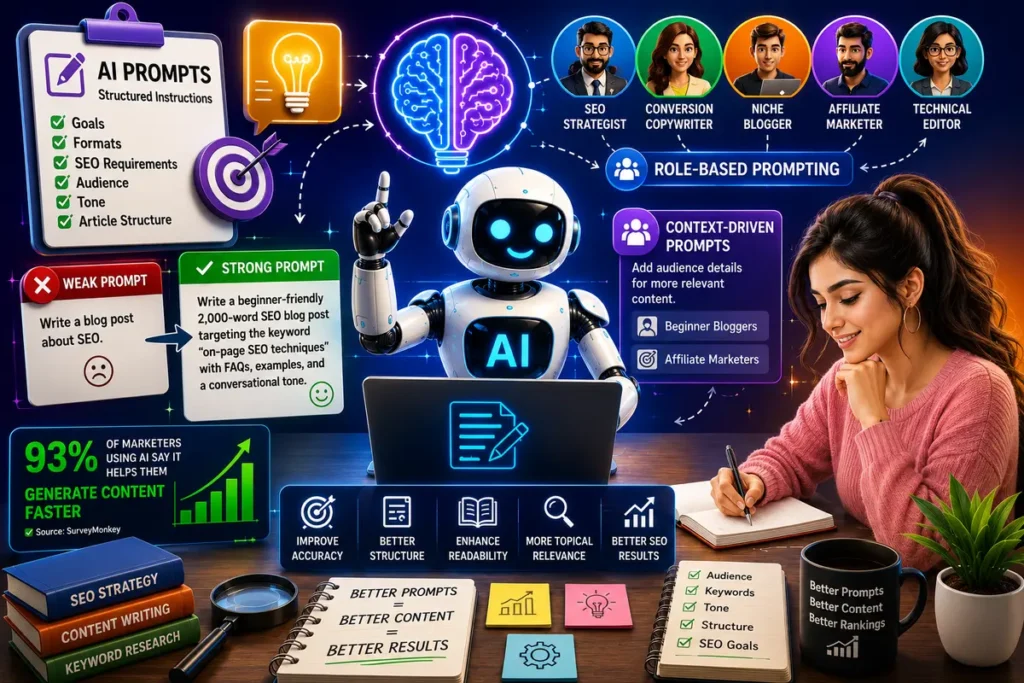
AI prompts for blog posts are structured instructions that guide AI tools to generate blog content based on specific goals, formats, and SEO requirements.
Actually, an AI prompt tells tools like Anthropic Claude, Google Gemini, or ChatGPT exactly what type of content you want. Instead of asking AI to “write a blog post,” you provide context about your audience, keywords, tone, article structure, and optimization goals.
For example, a weak prompt might say:
“Write a blog post about SEO.”
Meanwhile, a strong prompt says:
“Write a beginner-friendly 2,000-word SEO blog post targeting the keyword ‘on-page SEO techniques’ with FAQs, examples, and a conversational tone.”
That single difference dramatically changes output quality.
Moreover, prompt quality directly affects AI content quality. Clear prompts reduce generic writing and improve structure, readability, and topical relevance.
According to SurveyMonkey research, 93% of marketers using AI say it helps them generate content faster, making prompt quality more important than ever. Source: SurveyMonkey
Additionally, “AI prompts for blog posts are structured instructions that guide AI tools to generate blog content based on specific goals, formats, and SEO requirements.”
If you want better rankings, first understand a strong keyword research strategy before creating AI-generated blog content.
How AI Prompts Guide Blog Writing?
AI prompts guide blog writing by defining the role, audience, tone, format, and SEO expectations for the generated content.
For example, you can instruct AI to behave like:
- An SEO strategist
- A conversion copywriter
- A niche blogger
- An affiliate marketer
- A technical editor
This process is called role-based prompting.
At the same time, context-driven prompts improve accuracy. For example, if you add audience details like “beginner bloggers” or “affiliate marketers”, that helps AI to generate more relevant explanations.
Furthermore, prompt engineering involves designing detailed AI instructions that improve the accuracy, structure, and usefulness of generated blog content.
Why Are AI Prompts Important for SEO Blogging?
AI prompts are important for SEO blogging because they improve content structure, reduce production time, and increase search visibility.
First, AI-assisted blogging dramatically speeds up content creation. Research on AI-generated content shows that AI-assisted workflows help marketers produce content faster and at lower operational cost when combined with structured prompting and human editing. Source: Arxiv Research
Second, better prompts improve SEO alignment. For example, prompts that include search intent, keyword placement rules, FAQ generation, and snippet formatting produce more optimized articles.
Third, AI prompts for blog posts reduce writer’s block. Instead of staring at a blank page, bloggers can instantly generate:
- Topic ideas
- Outlines
- Introductions
- Headlines
- FAQs
- CTAs
Plus, AI-generated blog posts perform better when prompts include audience context, search intent, article structure, and optimization goals.
How AI Prompts Improve Google Rankings?
AI prompts improve Google rankings by helping writers create structured, search-intent-focused content faster.
For example, AI-generated outlines can ensure articles include:
- Relevant headings
- Semantic keywords
- FAQs
- Internal links
- Featured Snippet answers
This structure improves crawlability and user engagement. In my own content workflow, improving prompt structure significantly reduced editing time and made articles easier to optimise for SEO and AI Overviews.
Additionally, Google AI Overviews and conversational AI tools prefer content that contains clear definitions, structured headings, concise explanations, and extractable answers.
That means formatting matters more than ever.
Why AI Visibility Matters in 2026?
AI visibility refers to how often your content appears inside AI-generated answers and conversational search tools.
For example, platforms like ChatGPT, Perplexity, Gemini, and Grok increasingly summarize websites directly inside search experiences. According to recent AI market reports, conversational AI platforms like ChatGPT, Gemini, and Perplexity are rapidly changing how users search for information beyond traditional search engines. Source: TechRadar
As such, bloggers now need to optimize for:
- AI citations
- AI Overviews
- Extractable answers
- Conversational search visibility
For better optimization results, combine AI prompts with proven on-page SEO techniques and search intent targeting.
How Do AI Prompts Work for Blog Writing?
AI prompts work for blog writing by combining instructions, context, formatting, and optimisation goals into a structured request.
As a reasult, effective prompts usually contain five components:
Prompt Element | Purpose | Example |
Role | Defines expertise | “Act as an SEO strategist” |
Audience | Defines readers | “Write for beginner bloggers” |
Goal | Defines outcome | “Create a ranking blog post” |
Formatting | Defines structure | “Use H2s, FAQs, and bullets” |
SEO Rules | Defines optimization | “Target keyword in headings” |
How Does Role-Based Prompting Improve AI Blog Writing?
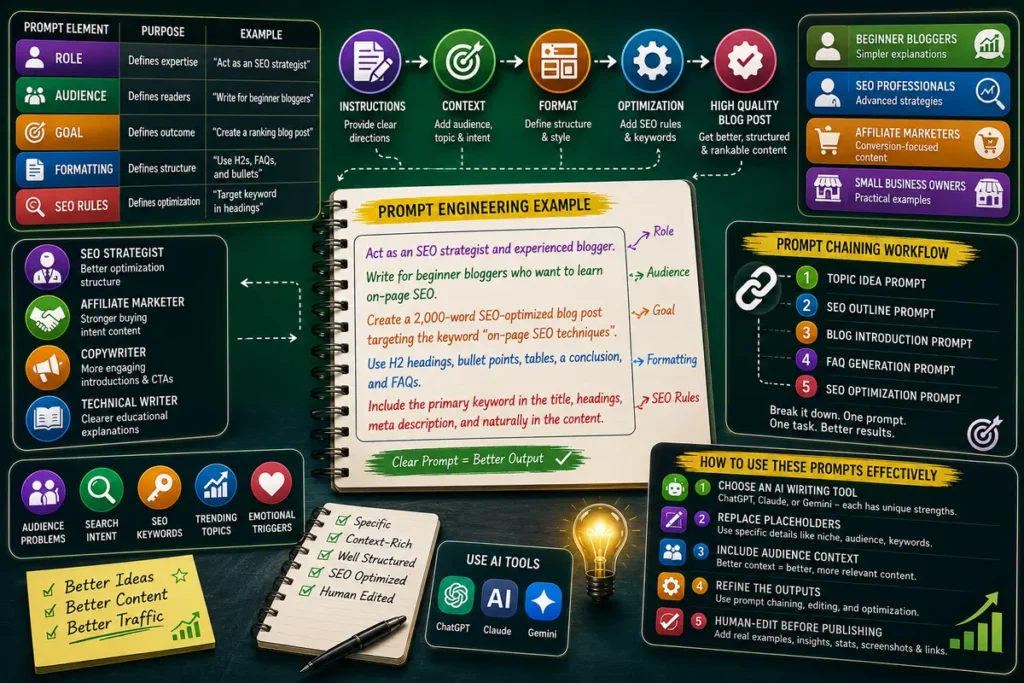
Role-based prompting improves AI output quality by telling the tool what type of expertise to follow before generating content. Instead of using generic instructions, you guide the AI with a specific role to create more accurate, niche-focused, and human-like writing.
For example:
- SEO strategist → better optimization structure
- Affiliate marketer → stronger buying intent content
- Copywriter → more engaging introductions and CTAs
- Technical writer → clearer educational explanations
A prompt like “Act as a senior affiliate marketer and write a product comparison article” usually produces more targeted results because the AI understands the tone, expertise level, and writing style expected in the output.
Why Does Context Improve AI Content Quality?
Context-driven prompting improves AI content quality by providing the tool with more information about your audience, goals, and search intent before it generates content. The more specific the context, the more accurate and relevant the output usually becomes.
For example:
- beginner bloggers → simpler explanations
- SEO professionals → advanced strategies
- affiliate marketers → conversion-focused content
- small business owners → practical examples
A simple instruction like “The audience consists of beginner bloggers struggling with SEO” can completely change the tone, structure, examples, and readability of the generated content.
What Is Prompt Chaining in AI Blog Writing?
Prompt chaining is the process of breaking blog writing into smaller AI prompts instead of generating the entire article in a single request. This approach usually creates more accurate, structured, and higher-quality content.
For example, most advanced AI blogging workflows follow steps like:
- Topic idea prompt
- SEO outline prompt
- Blog introduction prompt
- FAQ generation prompt
- SEO optimization prompt
Instead of forcing AI to handle everything at once, prompt chaining improves consistency, readability, and overall content quality by focusing on one task at a time.
You can also improve click-through rates by learning how to write meta descriptions that attract more search traffic.
What Are the Best ChatGPT Prompts for Blog Post Ideas?
AI blog idea prompts help bloggers to generate faster content ideas, stronger article angles, and better SEO-focused topics. Instead of brainstorming manually, structured prompts help AI discover keywords, audience pain points, trending topics, and content opportunities more efficiently.
The best blog ideation prompts usually combine:
- audience problems,
- search intent,
- SEO keywords,
- trending topics,
- and emotional triggers.
This approach helps generate blog ideas that are more likely to rank, attract clicks, and match what readers are actively searching for.
How to Use These AI prompts for blog posts Effectively?
AI prompts work best when you customize them to your niche, audience, and SEO goals rather than blindly copying them.
- Choose an AI writing tool like ChatGPT, Claude, or Gemini. Each platform generates slightly different outputs depending on writing style, context understanding, and prompt interpretation.
- Replace placeholders like [KEYWORD], [TOPIC], or [AUDIENCE] with highly specific details. For example, instead of using “fitness,” use “home workouts for busy professionals.”
- Include audience context inside your prompts. AI-generated content becomes significantly better when the tool understands who the article is written for and what search intent it should satisfy.
- Refine the outputs instead of publishing them instantly. Strong AI workflows use prompt chaining, editing, and optimisation to improve quality.
Always human-edit AI-generated content before publishing. Add real examples, personal insights, updated statistics, screenshots, and internal links to improve trust and originality.
15 AI prompts for blog posts Topic Ideas
Prompt 1-5
- Low-Competition Blog Idea Prompt
“Act as an SEO strategist and generate 20 low-competition blog post ideas in the [NICHE] niche that have informational search intent, high long-term traffic potential, and are beginner-friendly. Include suggested keywords, estimated user intent, and why each topic could rank well in Google and AI search engines.”
- Viral Blog Topic Prompt
“Generate 15 viral blog post ideas around [TOPIC] using curiosity-driven angles, emotional triggers, trend-based hooks, and social-sharing psychology. Make the titles optimized for both high click-through rates and SEO visibility.”
- Evergreen Content Prompt
“Create 20 evergreen blog post ideas for [AUDIENCE] that will remain relevant for years, solve ongoing problems, and attract consistent organic traffic. Include why each topic has long-term ranking potential.”
- Content Cluster Prompt
“Build a complete content cluster around the keyword [KEYWORD], including one pillar page idea and 15 supporting article ideas connected through internal linking strategy. Make the structure SEO-focused and optimized for topical authority.”
- Audience Pain Point Prompt
“Generate blog post ideas based on the biggest frustrations, fears, mistakes, and goals of [TARGET AUDIENCE]. Focus on topics that create strong emotional connection and high engagement potential.”
Prompt 6-10
- Trending Topic Discovery Prompt
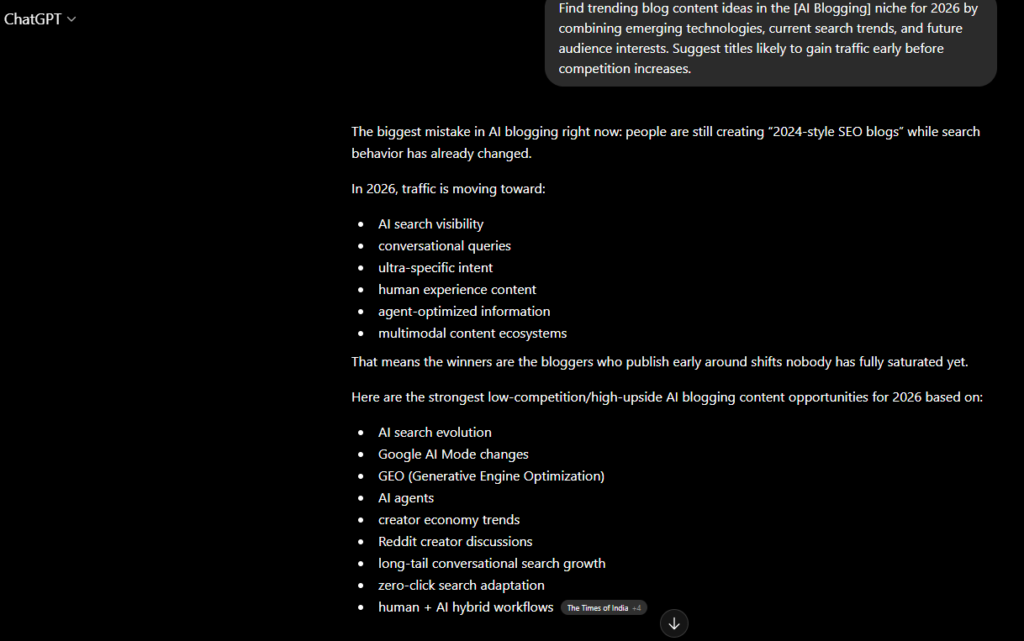
“Find trending blog content ideas in the [INDUSTRY] niche for 2026 by combining emerging technologies, current search trends, and future audience interests. Suggest titles likely to gain traffic early before competition increases.”
- AI Overview Optimization Prompt
“Generate blog post ideas specifically optimized for Google AI Overviews and conversational AI tools by focusing on question-based searches, concise educational topics, and extractable answer formats.”
- Beginner Guide Prompt
“Create beginner-friendly blog topic ideas for people completely new to [TOPIC]. Make the ideas easy to understand, highly searchable, and structured to build trust with first-time readers.”
- Listicle Blog Prompt
“Generate 20 SEO-friendly listicle blog titles around [TOPIC] that combine numbers, actionable advice, and curiosity-driven wording to improve click-through rates and social shares.”
- Comparison Article Prompt
“Suggest high-traffic comparison blog ideas in the [NICHE] industry, including product comparisons, strategy comparisons, and tool-versus-tool content optimized for affiliate traffic and buyer intent.”
Prompt 11-15
- Tutorial Blog Prompt
“Generate detailed tutorial blog post ideas that teach readers how to achieve a specific result step-by-step using practical examples, tools, and beginner-friendly explanations.”
- Keyword Expansion Prompt
“Expand the keyword [KEYWORD] into 50 related long-tail keyword ideas grouped by informational, commercial, and transactional intent. Include blog topic suggestions for each keyword category.”
- Emotional Headline Prompt
“Create emotionally compelling blog titles around [TOPIC] using urgency, fear of missing out, curiosity, speed, simplicity, or result-driven language while keeping them SEO-friendly.”
- Affiliate Blog Prompt
“Generate affiliate-focused blog topic ideas around [PRODUCT CATEGORY] that combine search intent, product research behavior, and SEO-friendly buying keywords likely to convert into commissions.”
- Seasonal Content Prompt
“Create seasonal blog post ideas for [INDUSTRY] based on holidays, yearly trends, and recurring audience interests. Include the best publishing time for each topic to maximize organic traffic.”
Viral Blog Angle Prompt
Viral blog angle prompts help transform ordinary topics into more curiosity-driven and clickable content ideas. Instead of generating basic headlines, these prompts focus on emotional triggers like speed, mistakes, fear of missing out, trends, or results.
For example, prompts using:
- curiosity → increase clicks
- urgency → improve engagement
- trends → attract faster traffic
- results-focused wording → improve CTR
A prompt like “Generate 10 curiosity-driven blog titles around [TOPIC] using fear, speed, results, or trend-based angles” usually creates more attention-grabbing headlines compared to generic SEO titles.
What Are the Best AI Prompts for SEO Blog Writing?
SEO blog prompts help AI generate content that is better optimized for Google rankings, Featured Snippets, AI Overviews, and user search intent. Instead of creating generic articles, structured SEO prompts guide AI to produce more organized, readable, and search-friendly content.
The best SEO AI prompts for blog posts usually focus on:
- keyword optimization,
- search intent,
- semantic headings,
- FAQ generation,
- Featured Snippet formatting,
- and AI-friendly structure.
This approach helps bloggers create content that is easier for both readers and search engines to understand.
AI Prompts for SEO Blog Outlines (16–30)
Prompts 16-20
- Complete SEO Outline Prompt
“Act as an expert SEO strategist and create a detailed long-form blog outline targeting the keyword [KEYWORD]. Structure the article using SEO-friendly H2 and H3 headings, include search intent optimization, semantic keywords, FAQ opportunities, and sections designed for Google Featured Snippets and AI Overviews.”
- Semantic Heading Prompt
“Generate SEO-optimized H2 and H3 headings for a blog post about [TOPIC] using semantic keyword variations, related search terms, and question-based queries people commonly search on Google.”
- Featured Snippet Structure Prompt
“Create a blog outline specifically optimized for Featured Snippets by including concise definition sections, numbered lists, comparison tables, and short answer-first paragraphs under each heading.”
- Search Intent Prompt
“Analyze the keyword [KEYWORD] and build a blog outline matching informational, commercial, or transactional search intent. Explain why each section supports user intent and improves ranking potential.”
- EEAT Blog Structure Prompt
“Generate an EEAT-focused blog outline for [TOPIC] that demonstrates expertise, experience, authority, and trustworthiness through examples, statistics, actionable advice, expert insights, and credible references.”
Prompts 21-25
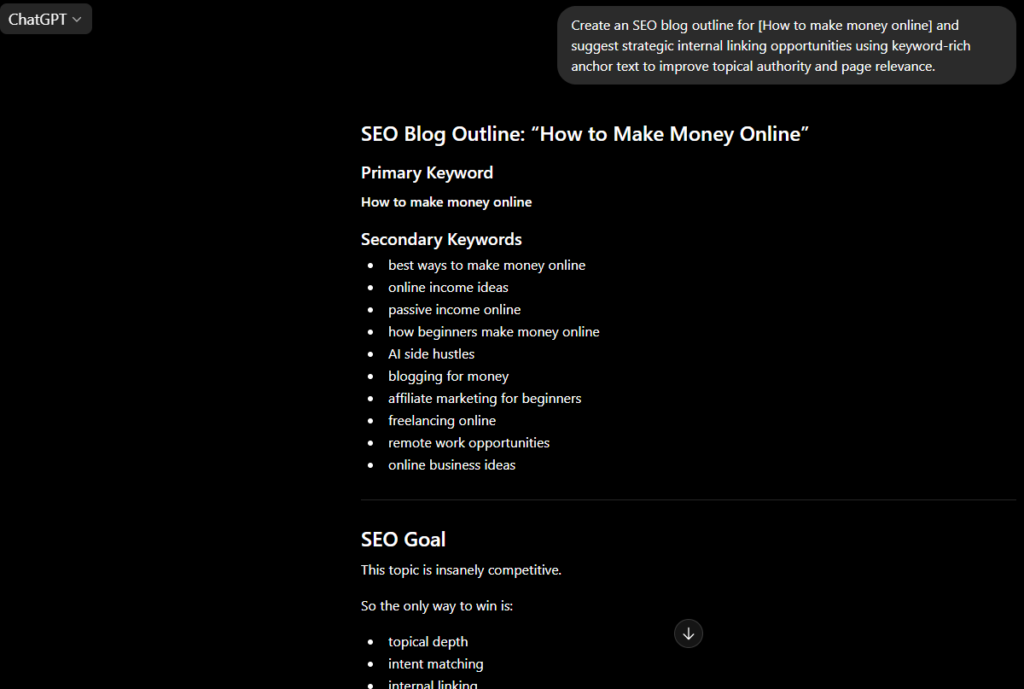
- Internal Linking Prompt
“Create an SEO blog outline for [TOPIC] and suggest strategic internal linking opportunities using keyword-rich anchor text to improve topical authority and page relevance.”
- Pillar Content Prompt
“Develop a pillar page outline around [KEYWORD] with supporting subtopics, cluster content ideas, and logical internal linking paths designed to improve topical authority and long-term SEO growth.”
- Beginner-Friendly Outline Prompt
“Write a beginner-friendly SEO blog structure about [TOPIC] that explains concepts in simple language, uses step-by-step formatting, and answers common beginner questions clearly.”
- Advanced Expert Outline Prompt
“Generate an advanced-level blog outline for experienced professionals in the [NICHE] industry. Include technical sections, expert strategies, case study opportunities, and deeper analysis beyond beginner content.”
- Supporting Keyword Prompt
“Create a blog outline around [KEYWORD] and naturally integrate supporting long-tail keywords, related semantic phrases, and People Also Ask questions to improve topical relevance.”
Prompts 26-30
- FAQ Schema Prompt
“Generate a FAQ section optimized for SEO and FAQ schema markup around the keyword [KEYWORD]. Include concise answers designed for voice search and AI-generated search results.”
- AI Overview Optimization Prompt
“Build a blog outline optimized for Google AI Overviews by using clear definitions, standalone explanations, concise educational sections, and extractable answers under each heading.”
- Comparison Article Prompt
“Create a structured comparison article outline for [TOPIC A] vs [TOPIC B] including feature comparisons, pros and cons, use cases, pricing differences, and decision-making sections optimized for SEO.”
- Content Brief Prompt
“Generate a complete SEO content brief for the keyword [KEYWORD] including target audience, search intent, competitor analysis, semantic keywords, article structure, FAQs, and optimization recommendations.”
- AI Citation-Friendly Prompt
“Rewrite this blog outline into an AI-citation-friendly structure using concise headings, definition-first paragraphs, FAQ sections, and standalone explanations designed for ChatGPT, Perplexity, and Google AI Overviews.”
AI Prompts for Blog Introductions (31–40)
Prompts 31-35
- PAS Introduction Prompt
“Write a highly engaging blog introduction for the keyword [KEYWORD] using the PAS copywriting framework (Problem, Agitation, Solution). Start by identifying the reader’s biggest frustration, intensify the consequences of ignoring it, and then introduce the article as the practical solution.”
- Curiosity-Driven Intro Prompt
“Create a curiosity-focused blog introduction around [TOPIC] that immediately grabs attention using an unexpected statement, controversial insight, or surprising trend. Make readers feel compelled to continue reading to discover the full explanation.”
- Storytelling Introduction Prompt
“Write a storytelling-style blog intro for [TOPIC] using a relatable real-world scenario, emotional tension, and a natural transition into the article’s main lesson. Keep the tone conversational and human-like.”
- Beginner-Friendly Intro Prompt
“Generate a beginner-friendly introduction for a blog post targeting people completely new to [TOPIC]. Explain the subject in simple language, reduce confusion, and make readers feel confident about learning the topic.”
- Statistics-Based Intro Prompt
“Create a blog introduction using a recent statistic or industry trend related to [TOPIC] to instantly build credibility and authority. Explain why the statistic matters and connect it naturally to the article’s purpose.”
Prompts 36-40
- SEO-Focused Intro Prompt
“Write an SEO-optimized introduction targeting the keyword [KEYWORD] naturally within the first paragraph while maintaining readability, conversational tone, and strong user engagement signals.”
- Conversational Tone Intro Prompt
“Generate a casual conversational blog introduction for [TOPIC] that feels natural, relatable, and easy to read while still sounding authoritative and trustworthy.”
- Authority-Style Intro Prompt
“Write a professional authority-style introduction for [TOPIC] that positions the article as an expert resource using confident language, industry insights, and strong value-driven messaging.”
- Short Punchy Intro Prompt
“Create a short, high-impact introduction for [TOPIC] using concise sentences, bold statements, and fast pacing designed to hook readers within the first few seconds.”
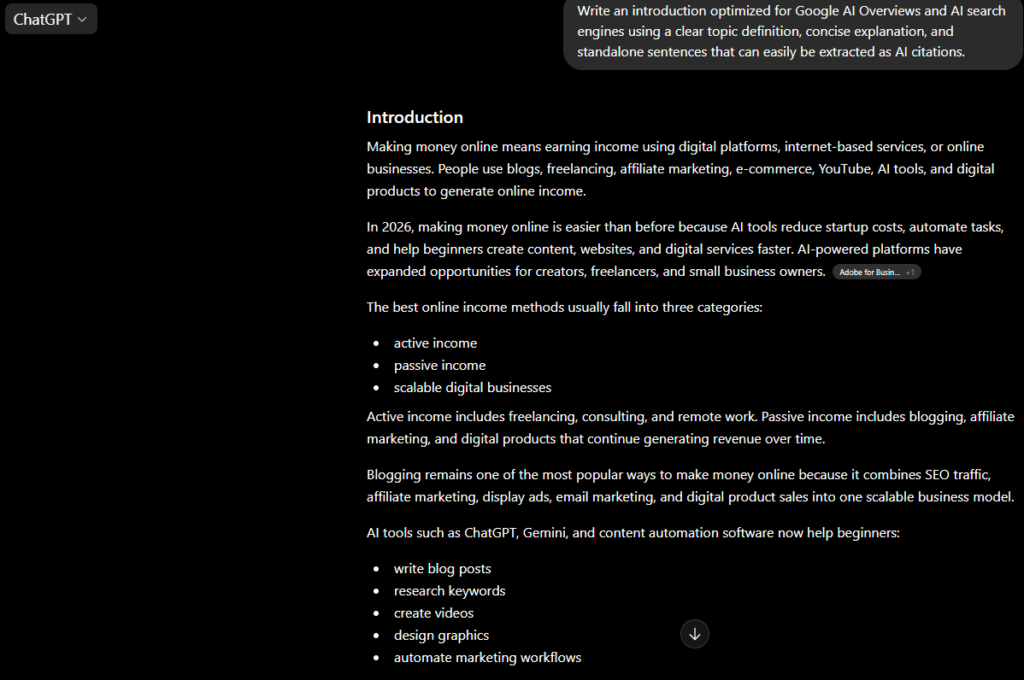
- Google AI Overview Intro Prompt
“Write an introduction optimized for Google AI Overviews and AI search engines using a clear topic definition, concise explanation, and standalone sentences that can easily be extracted as AI citations.”
AI Prompts for Long-Form Content Writing (41–50)
Prompt 41-45
- Complete Long-Form Blog Post Prompt
“Act as an expert SEO blog writer and create a detailed 2,500-word long-form blog post targeting the keyword [KEYWORD]. Use a conversational tone, SEO-optimized headings, semantic keywords, FAQs, examples, actionable tips, and formatting designed for Google rankings and AI search visibility.”
- Outline Expansion Prompt
“Expand this blog outline into a comprehensive long-form article while maintaining logical flow, smooth transitions, and consistent tone. Add practical examples, data points, and reader-friendly explanations under every section.”
- Human-Like Writing Prompt
“Rewrite this AI-generated article to sound more human, natural, and conversational by improving sentence variety, emotional connection, transitions, and readability while removing robotic phrasing.”
- Example Enhancement Prompt
“Analyze this blog post and add practical real-world examples, use cases, mini case studies, and relatable scenarios after every major concept to improve engagement and reader understanding.”
- Beginner-Friendly Explanation Prompt
“Rewrite this technical blog content in simple beginner-friendly language without losing SEO value or important information. Use short explanations, relatable examples, and easy-to-understand formatting.”
Prompt 46-50
- AI Citation Optimization Prompt
“Rewrite this article section into concise, standalone paragraphs optimized for ChatGPT citations, Google AI Overviews, and conversational AI search engines. Make each paragraph self-contained and directly answer user questions.”
- Expert Insight Prompt
“Add expert-level insights, advanced strategies, industry best practices, and professional recommendations to this blog post to improve EEAT signals and authority perception.”
- Transition Sentence Prompt
“Generate smooth transition sentences between each section of this blog post to improve readability, flow, and user experience while maintaining a conversational writing style.”
- Readability Improvement Prompt
“Improve the readability of this article by shortening overly complex sentences, removing repetitive wording, improving paragraph structure, and increasing clarity for mobile readers.”
- Actionable Takeaway Prompt
“Create a strong conclusion and key takeaway section for this blog post that summarizes the main lessons, reinforces practical benefits, and encourages readers to take immediate action.”
AI Prompts for SEO Optimization (51–60)
Prompts 51–55
- Meta Title Optimization Prompt
“Act as an SEO copywriting expert and generate 10 high-click-through-rate meta titles for the keyword [KEYWORD]. Keep each title under 60 characters, include the primary keyword naturally, and make them compelling enough to improve organic CTR from Google search results.”
- Meta Description Prompt
“Write 5 SEO-optimized meta descriptions for the keyword [KEYWORD] under 155 characters that improve click-through rate, summarize the article clearly, and encourage users to visit the page.”
- Schema Markup Prompt
“Analyze this blog post and suggest the best schema markup opportunities including FAQ schema, Article schema, HowTo schema, and Review schema to improve search visibility and rich result eligibility.”
- Image Alt Text Prompt
“Generate keyword-rich image alt text for all images in this article using descriptive, accessibility-friendly language while naturally including SEO keywords related to [TOPIC].”
- Featured Snippet Prompt
“Rewrite this article section into concise 40–60 word answers optimized for Google Featured Snippets using clear definitions, direct explanations, and standalone formatting.”
Prompts 56–60
- Readability SEO Prompt
“Improve the SEO readability of this article by shortening long sentences, simplifying difficult wording, improving paragraph structure, and increasing user engagement without removing important SEO keywords.”
- Internal Linking Prompt
“Suggest strategic internal linking opportunities for this blog post using keyword-rich anchor text connected to related articles, pillar pages, and supporting content to improve topical authority.”
- Semantic Keyword Prompt
“Generate a list of semantic keywords, NLP phrases, related entities, and contextual search terms related to [KEYWORD] that can improve topical relevance and search engine understanding.”
- Google AI Overview Optimization Prompt
“Rewrite this content to improve visibility in Google AI Overviews and conversational AI search engines by using concise paragraphs, definition-first formatting, question-based headings, and extractable answers.”
- SEO FAQ Prompt
“Create an SEO-friendly FAQ section around [KEYWORD] using real user search intent, People Also Ask style questions, concise answers, and formatting optimized for FAQ schema and AI-generated search results.”
Advanced AI Prompt Engineering Prompts (61–65)
Prompt 61–65
- SEO Content Audit Prompt
“Act as a senior SEO strategist and perform a complete audit of this blog post for the keyword [KEYWORD]. Analyze search intent alignment, heading structure, semantic keyword usage, readability, EEAT signals, internal linking opportunities, and AI Overview optimization. Then provide a prioritized action plan to improve rankings and user engagement.”
Prompt engineering works best when prompts include clear roles, context, and formatting expectations. Research from IBM and Google Cloud highlights that structured prompting improves response relevance and accuracy.
- Humanization Prompt
“Rewrite this AI-generated article to sound more natural, human, and conversational while preserving SEO optimization. Improve sentence rhythm, emotional tone, storytelling flow, and readability while removing robotic phrasing, repetitive patterns, and unnatural transitions.”
Advanced prompting techniques often focus on improving tone consistency and contextual understanding rather than simply making prompts longer.
- EEAT Optimization Prompt
“Analyze this article for Google EEAT improvements by identifying missing trust signals, weak expertise indicators, unsupported claims, and opportunities to add real-world examples, statistics, expert insights, and credibility-enhancing sections.”
According to modern prompt engineering best practices, prompts that specify expertise level, audience intent, and desired output structure consistently generate higher-quality responses.
- Topical Authority Prompt
“Create a topical authority strategy around the keyword [KEYWORD] by generating a pillar content plan, supporting cluster topics, internal linking structure, semantic keyword map, and content publishing sequence designed to improve long-term SEO visibility.”
Prompt chaining and structured workflows improve AI-generated content quality by breaking large tasks into smaller specialized steps.
- AI Blogging Workflow Prompt
“Build a complete AI-powered blogging workflow for [NICHE] covering keyword research, content ideation, SEO outlines, article drafting, optimization, internal linking, AI Overview optimization, publishing, and content refreshing. Structure the workflow step-by-step for scalable content production.”
Modern AI workflows increasingly rely on iterative prompting, reusable templates, and conversational refinement instead of one-time prompts.
[Internal link: “SEO blog writing checklist” → suggested target page/topic]
What is Featured Snippet Prompt?
Featured Snippet prompts help AI generate short, direct answers that are easier for Google to extract and display at the top of search results. These prompts usually focus on concise explanations, definition-first formatting, and question-based structure.
For better snippet optimization:
- answer the question immediately,
- keep responses concise,
- use simple language,
- and focus on clarity over complexity.
A prompt like “Answer the question ‘[KEYWORD QUESTION]’ in 40–60 words using clear, concise language optimized for Featured Snippets” usually improves extraction potential because Google prefers direct and easy-to-scan answers.
What is AI Overview Optimisation Prompt?
AI Overview optimization prompts help structure content in a way that is easier for Google AI Overviews, ChatGPT, and conversational search engines to understand and extract. Instead of long confusing paragraphs, these prompts focus on concise explanations, standalone answers, and clear formatting.
For better AI visibility:
- use direct definitions,
- keep paragraphs concise,
- answer questions immediately,
- and structure content with clear headings.
A AI prompts for blog posts like “Rewrite this article section into concise AI-citation-friendly paragraphs with clear definitions and standalone explanations” usually improves AI discoverability because modern AI search systems prefer content that is easy to scan, summarise, and quote.
Which AI Prompts Work Best for Affiliate Blog Posts?
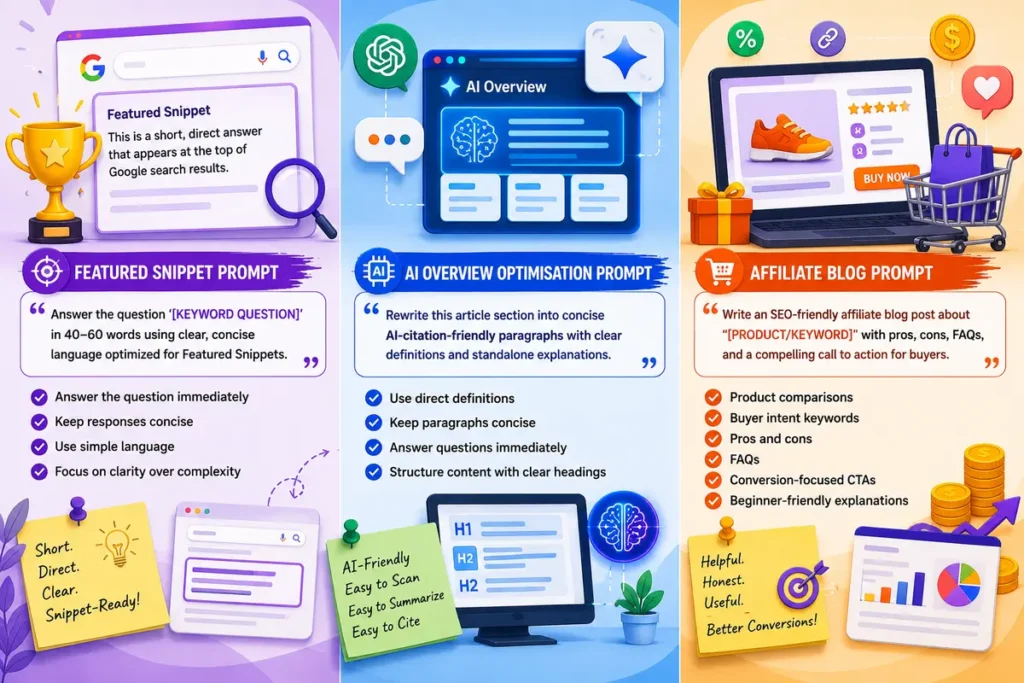
Affiliate blog prompts help bloggers create SEO-friendly buying content faster while improving conversions, structure, and search visibility. Instead of writing generic promotional articles, structured prompts help generate more trustworthy and intent-focused affiliate content.
The best affiliate AI prompts for blog posts usually focus on:
- product comparisons,
- buyer intent keywords,
- pros and cons,
- FAQs,
- conversion-focused CTAs,
- and beginner-friendly explanations.
This approach helps create affiliate blog posts that feel more useful, balanced, and human instead of overly sales-focused.
AI Prompts for Affiliate Blog Posts (66–75)
- Product Review Blog Prompt
“Act as an expert affiliate marketer and write a detailed SEO-optimized product review for [PRODUCT NAME]. Cover features, pros and cons, real-world use cases, pricing, beginner friendliness, and who should or should not buy it while maintaining an honest and trustworthy tone.”
- Pros and Cons Prompt
“Analyze [PRODUCT NAME] and generate a realistic pros and cons section based on usability, pricing, performance, customer experience, and value for money. Make the analysis balanced and beginner-friendly instead of overly promotional.”
- Product Comparison Prompt
“Create a detailed comparison article between [PRODUCT A] and [PRODUCT B] focusing on features, pricing, ease of use, SEO capabilities, support quality, and best use cases. Include a recommendation based on different user needs.”
- Buyer’s Guide Prompt
“Write a comprehensive buyer’s guide for people searching for the best [PRODUCT CATEGORY]. Explain important buying factors, common mistakes, must-have features, and how beginners can choose the right option.”
- Affiliate CTA Prompt
“Generate 10 high-converting affiliate call-to-action examples for [PRODUCT] that sound natural, trustworthy, and benefit-focused instead of aggressive or spammy.”
- Honest Product Summary Prompt
“Create a concise and honest product summary for [PRODUCT NAME] explaining what it does best, its biggest limitations, and the type of user who would benefit most from using it.”
- SEO Heading Prompt for Affiliate Posts
“Generate SEO-friendly H2 and H3 headings for an affiliate blog post targeting the keyword [KEYWORD]. Include comparison sections, FAQs, benefits, drawbacks, and buyer intent-focused headings.”
- Product FAQ Prompt
“Create a detailed FAQ section for [PRODUCT NAME] answering the most common buyer questions related to pricing, features, ease of use, refunds, support, alternatives, and beginner suitability.”
- Conversion-Focused Description Prompt
“Write a persuasive product description for [PRODUCT NAME] that highlights benefits, solves audience pain points, and encourages conversions while maintaining a human-like conversational tone.”
- Trust-Building Affiliate Disclaimer Prompt
“Write a transparent affiliate disclaimer for a blog post promoting [PRODUCT NAME]. Make it sound professional, trustworthy, reader-friendly, and compliant with modern affiliate marketing best practices.”
Many successful bloggers combine these prompts with a structured affiliate blogging strategy to improve conversions and SEO traffic.
What is Product Comparison Prompt?
Product comparison prompts help create more structured, balanced, and conversion-focused affiliate content by comparing products based on the factors buyers actually care about. Instead of writing generic reviews, these prompts organize information in a way that improves readability and decision-making.
The best comparison prompts usually focus on:
- pricing,
- features,
- ease of use,
- performance,
- beginner friendliness,
- and real-world use cases.
A AI prompts for blog posts like “Compare [Product A] and [Product B] based on pricing, features, SEO performance, ease of use, and beginner friendliness” usually creates more useful and trustworthy comparison content that is easier for readers to scan before making a purchase decision.
What Mistakes Should You Avoid When Using AI for Blogging?
Common AI blogging mistakes reduce content quality, rankings, and trustworthiness.
Vague prompts create generic outputs. For example, “write a blog about SEO” produces weak content because it lacks audience and intent context.
Many bloggers ignore EEAT principles. Google increasingly rewards expertise, originality, and trust signals.
Publishing raw AI text without editing often creates repetitive phrasing and factual inaccuracies.
According to recent enterprise AI reports, businesses are rapidly adopting AI-powered workflows, but trust, accuracy, and quality control remain major challenges as AI usage scales across teams and content systems. Source: McKinsey
Biggest AI Prompting Mistakes
Avoid these common issues:
- No target audience
- Missing search intent
- Weak formatting instructions
- No tone guidance
- Ignoring SEO structure
- Publishing without editing
- Overusing AI-generated text
How to Humanize AI Content
Humanized AI content combines AI efficiency with real experiences, editing, and natural writing style to make articles feel more authentic and trustworthy. Instead of publishing raw AI output, strong bloggers refine the content to sound more personal, useful, and reader-focused.
The best ways to humanize AI-generated content include:
- adding personal experiences,
- using real examples,
- including case studies,
- updating statistics,
- improving transitions,
- and adjusting the brand voice.
This approach helps AI-generated articles feel more natural, improve reader trust, and maintain stronger EEAT signals for SEO. For example, adding real experiences, screenshots, and personal opinions often made AI-generated content perform better compared to lightly edited raw outputs.
Which AI Tools Are Best for Blog Writing and SEO?
AI blogging tools help marketers create, optimize, and scale content production faster without handling every step manually. Different tools focus on different strengths, so choosing the right platform depends on your workflow and content goals.
Some tools work better for:
- long-form blog writing,
- SEO optimisation,
- content research,
- AI editing,
- or topical authority planning.
Today, many bloggers combine multiple AI tools together instead of relying on a single platform for the entire content workflow.
Best AI Tools for Bloggers in 2026
Tool | Best For | Key Feature |
OpenAI ChatGPT | Long-form writing | Flexible prompting |
Anthropic Claude | Natural writing | Large context window |
Google Gemini | Research workflows | Google ecosystem |
Jasper AI Jasper | Marketing copy | Templates |
Semrush Semrush AI | SEO optimization | Keyword workflows |
Surfer SEO Surfer SEO | Content scoring | SERP optimization |
RankIQ RankIQ | Blogger SEO | Topic suggestions |
MarketMuse MarketMuse | Topical authority | AI content planning |
According to recent reviews and industry comparisons, tools like ChatGPT, Jasper, Claude, and Copy.ai continue leading AI-assisted content workflows for bloggers, marketers, and SEO teams focused on faster content production and optimisation. Source: TechRadar
If you want deeper platform comparisons, explore these best AI tools for bloggers for content creation and SEO workflows.
How Do You Build a Reusable AI Prompt Framework for Content Creation?
Reusable AI prompt frameworks help bloggers create faster, more consistent, and better-structured content without writing prompts from scratch every time. Instead of using random instructions, strong frameworks follow a repeatable structure that improves AI output quality.
Most effective prompt frameworks usually include:
- role,
- target audience,
- content goal,
- formatting instructions,
- SEO requirements,
- and tone guidance.
For example, a prompt like “Act as an SEO strategist and write a beginner-friendly 2,000-word blog post targeting the keyword ‘AI prompts for blog posts’ using FAQs, H2 headings, and conversational language” usually creates more organized and SEO-focused content compared to generic one-line prompts.
Reusable Prompt Template
Copy this framework:
Act as a [ROLE].
Write a [CONTENT TYPE] targeting the keyword [KEYWORD].
Audience: [TARGET AUDIENCE]
Search intent: [INTENT]
Tone: [TONE]
Requirements:
– Include H2s and H3s
– Use examples
– Add FAQs
– Optimize for Featured Snippets
– Include internal linking opportunities
– Write in human-like conversational language
What is Advanced Prompt Engineering Techniques?
Advanced prompt engineering techniques help improve AI accuracy, structure, and overall content quality by giving the tool clearer instructions and better context. Instead of relying on basic one-line prompts, experienced bloggers use layered prompting methods to generate more consistent and human-like results.
Some of the most effective techniques include:
- Multi-step prompts → break complex tasks into smaller instructions to improve accuracy and structure.
- Prompt chaining → generate content step-by-step instead of creating the entire article in one request.
- Few-shot examples → show AI sample outputs so it better understands the writing style and formatting expected.
- Output constraints → define rules like word count, tone, formatting, or SEO requirements to control the final result.
- Style references → guide AI using a specific writing tone or content style to make outputs feel more natural and brand-focused.
Research shows that detailed, context-rich AI prompts often generate more accurate, consistent, and higher-quality outputs compared to vague one-line instructions. Source: IBM
What Should You Do After Generating AI Blog Content?
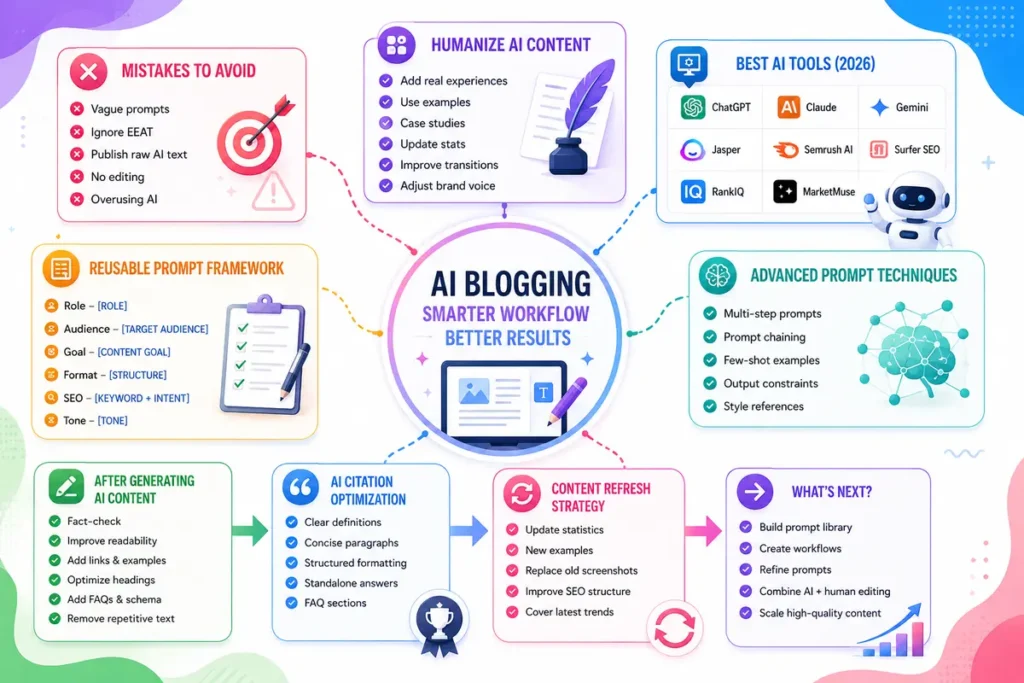
Post-generation optimization improves accuracy, rankings, and trustworthiness.
AI Content Editing Checklist
Editing AI-generated content is important because raw AI output often feels repetitive, generic, and poorly optimized. Strong editing improves readability, SEO quality, and overall trustworthiness.
- Fact-check statistics → verify data and sources because AI can sometimes generate inaccurate information.
- Improve readability → simplify wording and shorten long sentences to make the article easier to read.
- Add internal links → connect related articles to improve SEO structure and topical authority.
- Insert original examples → add real experiences or case studies to make the content more trustworthy.
- Optimize headings → use keyword-focused headings to improve search visibility and readability.
- Add schema-friendly FAQs → include concise FAQ sections to improve Featured Snippet opportunities.
- Improve transitions → make sections flow naturally instead of feeling disconnected or robotic.
- Remove repetitive phrases → edit repeated wording to make the content sound more human and engaging.
A strong internal linking strategy also helps distribute authority across related blog posts and improve crawlability.
AI Citation Optimization Workflow
AI citation optimization improves the likelihood of appearing in conversational search tools.
For example, citation-friendly content usually includes:
- Clear definitions → help AI systems understand the topic quickly and extract direct answers more accurately.
- Concise paragraphs → improve readability and make content easier for AI search tools to summarize.
- Structured formatting → organize information with headings and sections so AI can scan the content more efficiently.
- Standalone explanations → ensure each paragraph makes sense independently without needing extra context.
- FAQ sections → answer common user questions clearly, improving Featured Snippet and AI citation opportunities.
This structure makes content easier for Google AI Overviews, ChatGPT, and conversational search engines to understand and reference.
Content Refreshing Strategy
Content refreshing helps AI-generated articles maintain rankings, accuracy, and relevance over time instead of becoming outdated after a few months.
The best ways to refresh content include:
- updating statistics,
- replacing outdated screenshots,
- adding new examples,
- improving SEO structure,
- and covering recent trends.
Regular content updates help maintain search visibility and improve long-term SEO performance. In several AI-focused articles, simply updating outdated examples and statistics helped maintain rankings longer without rewriting the entire post.
What’s Next After Learning AI Prompt Engineering?
AI prompt engineering becomes more powerful when combined with SEO strategy, audience research, and human editing instead of relying only on AI-generated output.
The best next steps usually include:
- building a prompt library → organising prompts by blog ideas, SEO, affiliate content, FAQs, and content updates.
- creating repeatable workflows → improving consistency and speed across your content production process.
- refining prompts regularly → analyse which prompts generate better rankings, engagement, and AI visibility.
- combining AI with human editing → improves originality, trustworthiness, and overall content quality.
Today, many businesses and bloggers increasingly rely on AI-assisted workflows to scale content production more efficiently.
AI writing tools are becoming essential for bloggers, marketers, and SEO teams focused on faster content creation and scalability. Source: Forbes
Frequently Asked Questions About AI Prompts for Blog Posts
Q1. How do AI prompts improve SEO?
AI prompts improve SEO by helping writers generate optimized headings, semantic keywords, FAQs, Featured Snippet sections, and AI-friendly content structures faster.
Q2. Can ChatGPT write complete blog posts?
Yes. ChatGPT can generate full blog posts, outlines, FAQs, introductions, and SEO sections. However, human editing remains essential for accuracy, originality, and brand voice.
Q3. Are AI-generated blog posts good for Google rankings?
AI-generated blog posts can rank well when they are properly edited, optimized for search intent, and enhanced with EEAT signals like expertise, examples, and trustworthiness.
Q4. Which AI tool is best for blogging?
ChatGPT, Claude, and Gemini are among the most popular AI blogging tools because they support long-form writing, prompt customization, and SEO-focused workflows.
Q5. How do you humanize AI-generated blog content?
You can humanize AI-generated content by adding personal experiences, case studies, examples, statistics, expert opinions, and natural conversational editing.
Conclusion
AI prompts for blog posts are changing how modern bloggers create, optimize, and scale content in 2026.
After testing dozens of AI blogging workflows, one thing became clear – better prompts almost always produce better content quality, SEO structure, and publishing efficiency.
Start small:
- test a few prompts,
- refine them for your niche,
- track what performs best,
- and build your own repeatable AI blogging system over time.
Because one well-optimised prompt can completely change the quality of your content workflow.
Now I’m curious – which type of AI prompt helps you the most right now:
- blog ideas,
- SEO optimisation,
- affiliate content,
- or AI Overview ranking?
Drop your answer in the comments below. Also, if you have any questions, then ask. I am waiting to reply to you…
Written by Pratap Keshari Panda – Digital marketer, SEO-focused blogger, and AI content strategy specialist helping creators grow traffic with AI-powered workflows.
Reviewed by Editorial SEO & AI Optimization Team – Specialized in search visibility, AI citation optimization, and long-form content strategy.

 350+ Blog Guides Published
1 Comment
Your comment is awaiting moderation.
Spinning here feels like a breath of fresh air compared to other busy websites. The interface is light, the rounds are fair, and I never deal with confusing menus. I keep coming back because the whole experience matches what players actually want. A solid choice for anyone chasing a laid back gaming day. thvm9slot
Your comment is awaiting moderation.
I prefer playing on my phone and finding a stable APK was always a headache until I discovered this place. The app runs perfectly on my device and the touch controls are very responsive. I can track my bets and claim daily rewards without any issues. It makes mobile gambling so much more convenient. jugabetdescargarapk
Your comment is awaiting moderation.
I was looking for a reliable sports and casino combo and this place delivered. The betting odds are competitive and the cashout process takes only a few hours. Staff is professional and always ready to assist. This is my new go to platform. 277ctb
Your comment is awaiting moderation.
Downloaded the app on a whim and ended up staying way longer than I planned. The layout is super intuitive even for someone like me who is not tech savvy. Got my first payout processed within the hour which really proved the point. Thanks for making entertainment actually fun again. krbunker
Your comment is awaiting moderation.
Right away I am ready to do my breakfast,
when having my breakfast coming yet again to read other news.
[…] you need ready-to-use examples, explore our collection of ChatGPT prompts for blogging to create better content faster with less […]