

Table of Contents
ToggleIntroduction
Do you know keyword research is how much important for SEO? But if you’re still doing it manually, you’re wasting time and probably targeting the wrong keywords. In this guide, you’ll learn how to do Keyword research using AI to find low-competition, high-ranking keywords faster-and actually get results.
Key Takeaways
- AI keyword research reduces keyword research time by up to 70% while improving keyword accuracy.
- Seed keywords act as the foundation for generating long-tail keyword ideas using AI tools.
- Long-tail keywords have lower competition and higher conversion potential for beginners.
- Search intent classification ensures keywords match what users actually want.
- Keyword clustering groups related keywords into topics, improving SEO structure and rankings.
- Validation tools like Google Keyword Planner or Ahrefs are essential before finalizing keywords.
- Consistent execution of AI-assisted keyword research leads to faster SEO growth and scalability.
What Is AI Keyword Research and How Does It Work?

AI keyword research is the process of using artificial intelligence tools to generate, analyse, and optimize keywords for SEO.
It replaces manual guesswork by using data patterns, natural language processing, and automation. For example, instead of manually brainstorming keywords, you can prompt AI to generate hundreds of ideas instantly.
For example, if you enter “blogging for beginners,” AI can generate:
- How to start a blog in 2026
- Best blogging niches for beginners
- Blogging mistakes to avoid
Also, AI tools can analyse search intent, keyword difficulty, and trends in seconds. For example, if you enter “blogging for beginners,” AI can suggest variations like “how to start a blog in 2026” or “best blogging niches for beginners.”
That’s why, AI speeds up the entire workflow. According to HubSpot, 94% of marketers plan to use AI for content creation.
I am sharing my experience; I see so many beginners waste weeks on manual keyword research when AI can produce better results for them in under 30 minutes.
Keyword research using AI involves generating seed keywords, expanding them into long-tail variations, and validating them with SEO tools.
For deeper understanding, check this How to Find Low Competition Keywords (Beginner-Friendly, Practical SEO Guide for 2026)
Why AI Keyword Research Matters in 2026
AI keyword research matters because it dramatically reduces time, improves accuracy, and gives a competitive SEO advantage.
First, AI reduces research time by up to 70%. For example, what used to take 3–4 hours manually can now be done in 20–30 minutes.
Second, AI improves keyword discovery. According to SEMrush, long-tail keywords make up over 70% of all search queries.
Third, AI enables better clustering. This helps you build topical authority, which Google prioritizes for rankings.
AI tools speed up keyword research by automating idea generation, intent analysis, and topic clustering.
Personally, I’ve seen blogs grow from 0 to 10K traffic/month just by switching from random keyword targeting to AI-driven clustering.
That being said, speed alone isn’t enough-you need a system. Let’s break it down.
How to Do Keyword Research Using AI Step by Step?
Keyword research using AI is the process of generating, analyzing, and validating keywords using artificial intelligence tools to find low-competition, high-ranking search terms faster.
You can do AI keyword research in 6 simple steps:
- Generate seed keywords using AI tools
- Expand into long-tail keywords
- Identify search intent
- Analyze keyword competition
- Cluster keywords into topics
- Validate using SEO tools
AI keyword research helps you find profitable keywords faster, reduce manual effort, and improve SEO rankings.
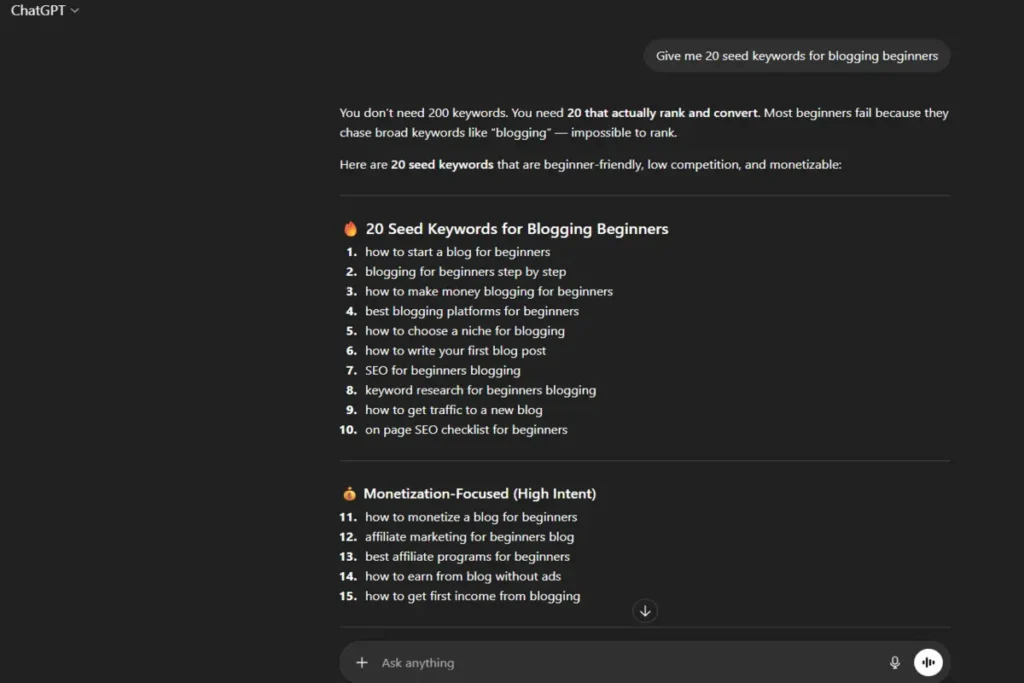
Step 1: Generate Seed Keywords Using AI
Seed keywords are basic topic ideas that act as the starting point for keyword research.
First, ask AI simple prompts like:
- “Give me 20 seed keywords for blogging beginners”
- “List SEO topics for affiliate marketing”
For example, AI might generate:
- Blogging tips
- SEO basics
- Content marketing
This connects with your niche. If you’re unsure, explore “best blogging niches that make money“
Mistake I see often that beginners choose random topics without niche clarity.
Step 2: Expand into Long-Tail Keywords
Long-tail keywords are search queries with lower competition and higher intent, making them easier to rank for beginners.
Next, use prompts like:
- “Expand these keywords into long-tail keywords”
- “Find low competition keywords for [topic]”
For example:
- “Blogging tips” → “blogging tips for beginners in 2026”
According to Ahrefs, long-tail keywords have 3–5x higher conversion rates,
This is where most beginners win or lose, long-tail keywords decide your ranking speed.
Step 3: Identify Search Intent
Search intent is the purpose behind a user’s search query.
Then, classify keywords into:
- Informational
- Navigational
- Transactional
For example:
- “How to start a blog” → Informational
- “Best hosting for blogs” → Transactional
Ignoring intent is one of the biggest mistakes. Learn more: “common SEO mistakes beginners make”
If your content doesn’t match intent, it won’t rank-no matter how good it is.
Step 4: Analyze Competition
Keyword difficulty measures how hard it is to rank for a keyword.
Next, use tools like:
- Google Keyword Planner
- Ahrefs
- Ubersuggest
For example, target:
- Low KD (0–20) for beginners having 100-200 search volume
- Medium KD (20–40) for growth
According to the top result in Google gets 27.6% of clicks. Searchatlas.
Step 5: Cluster Keywords into Topics
Keyword clustering is the process of grouping related keywords into topics to improve SEO structure and rankings.
Then, group keywords like:
- “AI blogging tools”
- “Best AI writing tools”
- “AI content tools”
All belong to one topic cluster.
This helps build authority. Read: AI Blogging for beginners in 2026: How AI Helps Bloggers Write Faster and Grow Traffic.
Clustering is the difference between random blogging and strategic SEO.
Step 6: Validate with SEO Tools
Validation ensures AI-generated keywords are accurate and worth targeting.
Finally, cross-check:
- Search volume
- Competition
- CPC
For example, a keyword with 1,000 searches and low competition is ideal.
Never trust AI blindly-always validate before execution.
Which AI Tools Are Best for Keyword Research in 2026?
The best AI tools for keyword research combine idea generation, data analysis, and SEO validation.
Tool | Best For | Free/Paid |
ChatGPT | Idea generation & clustering | Free/Paid |
Google Keyword Planner | Search volume data | Free |
Ahrefs | Keyword difficulty & backlinks | Paid |
SEMrush | Competitive analysis | Paid |
Ubersuggest | Beginner-friendly SEO | Free/Paid |
Surfer SEO | Content optimization | Paid |
First, start with ChatGPT for brainstorming. Then validate using tools.
Explore more: “AI tools for blogging beginners” → AI tools list].
How to Find Low-Competition Keywords Using AI?
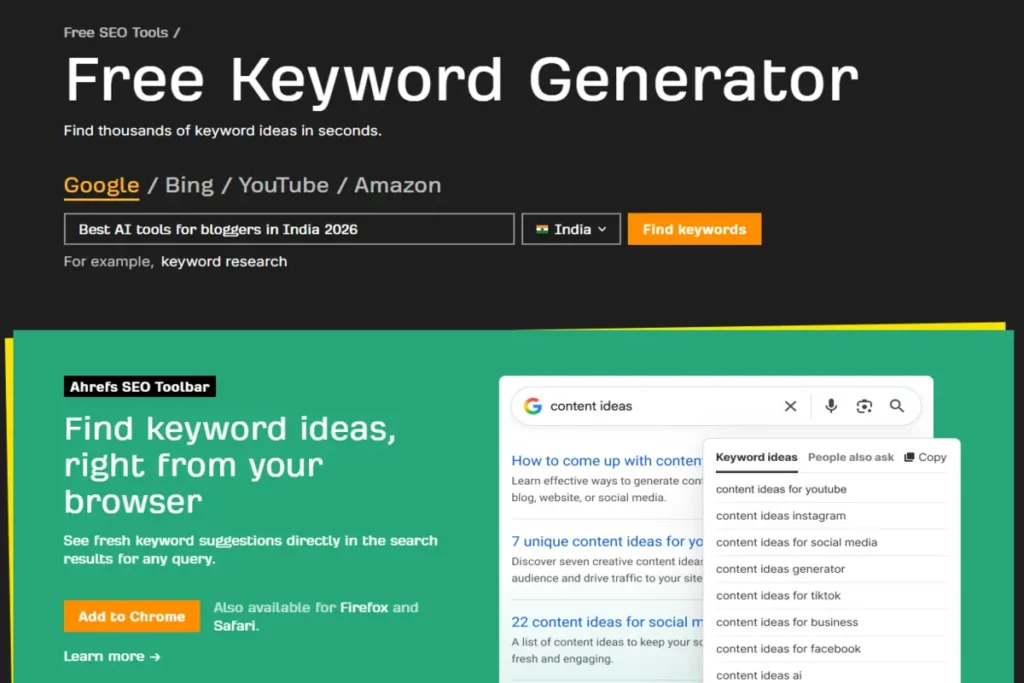
Low-competition keywords are search terms with lower ranking difficulty and higher chances of ranking quickly.
First, combine AI prompts with filters:
- “Find keywords with low competition and high intent”
- “List long-tail keywords with low KD”
Second, focus on:
- Question-based keywords
- Long-tail phrases
- Emerging trends
For example:
- “Best AI tools” → high competition
- “Best AI tools for bloggers in India 2026” → low competition
Third, validate using tools.
Low competition keywords AI strategies focus on specificity, intent, and niche targeting. The more specific the keyword, the easier it is to rank.
Can ChatGPT Replace Traditional Keyword Research Tools?
ChatGPT cannot fully replace traditional SEO tools but can significantly enhance keyword research workflows.
First, ChatGPT is excellent for:
- Generating ideas
- Clustering topics
- Understanding intent
Second, traditional tools are essential for:
- Search volume
- Keyword difficulty
- Competitive data
For example, ChatGPT might suggest a keyword, but only Ahrefs can confirm its difficulty score.
So, the smart strategy is hybrid.
Best strategy = AI + SEO tools combination.
How to Use AI for Keyword Clustering and Topic Research?
AI keyword clustering groups similar keywords into structured content topics for better SEO performance.
First, input a list of keywords into AI:
- “Cluster these keywords into topics”
Second, AI will group them logically.
For example, Cluster:
- 1: Blogging basics
- 2: SEO optimization
- 3: Monetization
This is how you build authority instead of writing random posts.
What Are the Common Mistakes in AI Keyword Research?
Common mistakes in AI keyword research include over-reliance on AI, ignoring intent, and skipping validation.
- Blindly trusting AI leads to poor results. AI generates ideas, not final answers.
- Ignoring search intent causes mismatched content.
- Targeting transactional keywords with informational content fails.
- Not validating keywords leads to wasted effort.
Avoid these errors: [Internal link: “common SEO mistakes beginners make“
How to Validate AI-Generated Keywords for SEO?
Keyword validation is the process of confirming search volume, competition, and relevance before targeting keywords.
First, check:
- Search volume
- Keyword difficulty
- CPC
Second, use tools like:
- Google Keyword Planner
- Ahrefs
Third, compare competitors.
For example, if top results are high-authority sites, skip that keyword.
As per my experience If a keyword has no volume, it has no value.

What to Do After Keyword Research?
After keyword research, the next step is to create optimized content and build SEO structure.
First, write content targeting your keywords. Use this guide: [Internal link: “how to write SEO-friendly blog posts” → content writing guide].
Second, optimize on-page SEO:
- Title tags
- Meta descriptions
- Internal links
Third, follow this: How to Write SEO Friendly Blog Posts (Easy & Practical Guide for Beginners)
Finally, scale content production.
Without a proper execution, keyword research is useless.
Frequently Asked Questions
Q1. What is AI keyword research?
AI keyword research is the process of using artificial intelligence tools to generate and analyze keywords for SEO faster and more efficiently.
Q2. How to find low competition keywords using AI?
You can find low competition keywords by generating long-tail keywords with AI and validating them using tools like Google Keyword Planner or Ahrefs.
Q3. Is AI keyword research good for beginners?
Yes, AI keyword research is beginner-friendly because it simplifies keyword discovery and reduces manual effort.
Q4. Can ChatGPT do keyword research?
ChatGPT can generate keyword ideas, clusters, and intent analysis, but you still need SEO tools for validation.
Q5. What are the best AI tools for keyword research?
The best tools include ChatGPT, Google Keyword Planner, Ahrefs, SEMrush, and Ubersuggest.
Conclusion
AI keyword research is a powerful method to find, analyze, and optimize keywords faster and more effectively than traditional methods.
AI is not magic-it’s a tool. The real advantage comes from execution.
By applying this system consistently, you can:
- Find low competition keywords
- Rank faster
- Scale your blog
If you want faster results, focus on action. Because in SEO, execution beats knowledge every time.
Also, explore: [Internal link: “how to rank blog posts faster” → ranking strategy post] and [Internal link: “blog monetization strategies” → monetization guide].
Now you have a clear idea about how to Do Keyword Research Using AI, So What’s your biggest struggle in keyword research right now?
- Finding low competition keywords
- Understanding search intent
- Choosing the right niche
Comment your answer – I’ll help you fix it.
Written by Pratap Keshari Panda
Digital Marketing Strategist | AI Blogging Expert
Helped bloggers scale traffic using AI-driven SEO systems
Reviewed by SEO Content Specialist
Expert in On-Page SEO, Content Strategy, and AI Optimization

 350+ Blog Guides Published


7 Comments
[…] understanding what your audience wants to learn. If you’re new to this process, our guide to keyword research for beginners can help you find topics with real traffic […]
[…] you want better rankings, first understand a strong keyword research strategy before creating AI-generated blog […]
[…] can follow a structured approach from our AI keyword research guide to find low-competition […]
[…] find the right keywords that actually rank, follow this AI keyword research guide for beginners […]
[…] Read: How to Do Keyword Research Using AI (Ultimate Guide to Find Low Competition Keywords Fast in 2026) […]
[…] Check my keyword research Guide.→ How to Do Keyword Research Using AI (Ultimate Guide to Find Low Competition Keywords Fast in 2026) […]
So valuable and very easy step by step guidance , Useful information.